[image source]
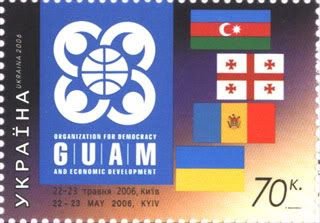
GUAM appears to be DOA, of course, but the article below suggests some degree of
coordination between MD and GE's Russia policies. I'm not sure I buy it, particularly as
I think the article overstates Acting President Ghimpu's influence on MD foreign policy.
And is wanting Russian troops to leave territory one claims as its own sufficiently strange
of a policy preference as to suggest that it must be the result of a coordinated campaign?
GUAM appears to be DOA, of course, but the article below suggests some degree of
coordination between MD and GE's Russia policies. I'm not sure I buy it, particularly as
I think the article overstates Acting President Ghimpu's influence on MD foreign policy.
And is wanting Russian troops to leave territory one claims as its own sufficiently strange
of a policy preference as to suggest that it must be the result of a coordinated campaign?
Nezavisimaya Gazeta [translation courtesy of JRL]
August 2, 2010
KISHINEV AND TBILISI NEVER NOTICED MOSCOW'S PROTESTS
Moldova and Georgia demand withdrawal of the Russian military from what they call their territories
Author: Svetlana Gamova
MOLDOVA AND GEORGIA COORDINATE THEIR RUSSIAN POLICIES
Their relations with Russia already soured, Moldova and Georgia got international support. The matter concerns the report on arms control agreements the U.S. Department of State published last Wednesday. The document mentioned presence of the Russian troops on the territories of Moldova and Georgia without their consent. By and large, the thesis in question repeated what State Secretary Hillary Clinton had said about occupation of Moldovan (Trans-Dniester region) and Georgian (Abkhazia and South Ossetia) territories by the Russian military. This statement was made when acting president of Moldova Mihai Ghimpu signed a special decree calling the Russian contingent in the Trans-Dniester region "occupiers" and demanding its withdrawal. The Russian Foreign Ministry then reiterated Moscow's official stand on the matter and gave the floor to Gennadi Onischenko of the Rospotrebnadzor.
Onischenko's words made it plain that Kishinev's objections to the presence of the Russian military in the Trans-Dniester region might cost it dearly. Russia suspended import of Moldovan wines - just to make the point. The Moldovans arranged negotiations to discuss the matter but the effort was wasted. That was when Clinton made her statement and urged Russia to start honoring its obligations. Her words killed the last chance the Moldovans might have had then to reactivate wine export to Russia.
Russian Foreign Ministry called "incorrect" U.S. Department of State's speculations on the presence of the Russian military in Moldova and Georgia. "There are no Russian soldiers in Georgia. As for Abkhazia and South Ossetia on whose territories Russian military bases operate with their consent, these countries are
neither parts or Georgia nor signatories of the Treaty on Conventional Armed forces in Europe." The Foreign Ministry reiterated that Russian peacekeepers were on the Dniester in accordance with the agreement between Russia and Moldova (July 21, 1992). The Moldovan authorities demand withdrawal of the Russian
military contingent and peacekeepers from the self-proclaimed Trans-Dniester Moldovan Republic in the hope to replace them with an international police force.
In any event, official Kishinev studiously ignored all objections and protests from Russia. Moreover, it chose to comment on the conclusions drawn in the U.S. Department of State's report in application to the conflict with Tiraspol. Kishinev no longer accepts the terms formulated by Moscow (conflict resolution first, evacuation of the military afterwards). Moldovan Ambassador to Romania Yuri Renice told the Romanian newspaper Adevarul, "Synchronization of the Russians' withdrawal with Trans-Dniester conflict resolution is a thoroughly counterproductive approach...Presence of the Russian military collides with the principle of neutrality promoted by the Constitution. Most Trans-Dniester residents stand for reintegration of the territory."
Trans-Dniester Foreign Ministry in the meantime appealed to the UN to recognize sovereignty of the Trans-Dniester Moldovan Republic in the light of the recent ruling of the International Court of Justice regarding Kosovo. "Our position is clear: the Trans-Dniester region is part of Moldova," said Renice.
Georgia took Washington's position as a clear confirmation: there are no sovereign Abkhazia and South Ossetia, there are but regions of Georgia occupied by Russia. Ghimpu said that he would pay an official visit to Tbilisi before long. It is clear that Kishinev and Tbilisi intend to coordinate their Russian policies.


No comments:
Post a Comment