Pundit Sees Attempts to Incite Anti-Western Sentiment as Threat to Russia Itself
Nezavisimaya Gazeta [translation from JRL]
August 4, 2010
Article by Georgiy Mirskiy: "Patriots' Fears -- West Not At All Interested in Weakening Russia"
[Institute of World Economy and International Relations]
"People want to weaken Russia ... what do you mean weaken it - they want to crush, dismember, subordinate it..." Who among us has not heard such cries? Journalists, TV and radio commentators, parliamentarians, generals, and professors compete with one another in their attempts to convince the Russian people that the West - and especially America - dreams only of causing catastrophic damage to our country, destroying it, taking things away from it. What is particularly interesting is the more our relationship with Western countries improves, the more vigorous and vociferous the counterattack becomes of those who implore: "Do not believe this! It is all lies! They are undermining our vigilance, they want to trap us!" And this mass brainwashing that has lasted for many years must inevitably produce results. In one opinion poll, almost a third of those who answered thought it possible that AIDS had been deliberately brought into Russia by the Americans.
In part, this has been happening since ancient times. In the century before last, when Queen Victoria ruled Britain, if Russia suffered any foreign policy failure, people usually said: "The Englishwoman is playing dirty tricks on us". In the Soviet era, it was customary to use one word to explain any accident - "saboteurs". Generally speaking, the attitude of Russian people to the West has always been ambivalent. Even two hundred or three hundred years ago, they knew that life in Europe was better, even much better. It was an axiom, just as people have always been convinced that customs in Russia will continue to remain as foul as they have ever been. You may recall Saltykov-Shchedrin: "Everybody steals, and at the same time everyone laughs loudly and says: well, where else do you see such an outrage?" But in order to compensate for this inferiority complex, it was necessary to develop the opposite complex - a superiority complex. A few years ago, viewers on one of the central TV channels were asked why it was that we had beaten Germany but the Germans lived better than us. Most of the votes, almost 40 %, went to the answer: "On the other hand, we are more heartfelt".
The conviction that everyone hates Russia and wants to play all kinds of dirty tricks on it is not based on any facts. The author has worked in America for nine years, has talked to the most varied of people, from former high-ranking individuals to black drivers on the Princeton University minibus. I have never heard anything bad about our country, on the contrary - there has always been only one leitmotif to their statements: "How can it be that Russia, such a great country, with such a great culture, with such talented people, with such natural riches, has finally got rid of totalitarianism, obtained its freedom, but we still get bad news from there?"
Of course, there are Russophobes in the West, just as there are anti-Semites and Islamophobes. But anti-American sentiment is also widespread throughout the world, it is enough to talk to French people, Turks, or Latinos; for example, I only actually know of two nations that really have a warm attitude towards America - the Poles and the Iraqi Kurds. But the Americans do not suffer from any complex because this. And we have no reason to complain about a bad attitude by foreigners; if our people do not themselves misbehave, they have a right to expect friendliness and benevolence everywhere.
I can foresee at least two objections: firstly, Americans and Europeans may not have anything against the Russians as a people, but they hate our regime, our state, and, secondly, even if the ordinary people there have some sympathy for us this is not of any significance - the position of politicians, capitalists, and the military is what is important. Well, what can be said in response to this.
It is true that people in America and Britain, for example, do not much like our regime. But do you think that they actually adore their own regimes? They curse them and change them every few years. And in any case, the words "regime" and "love" should not be combined at all, at least in democratic societies. It is usually only dictators and despots who are loved. Liking a ruler of one kind or another is another matter. It seems to me that of all the Russian rulers, only two were liked in the West - Catherine the Great and Mikhail Gorbachev. And the attitude there to the Russian state has since ancient times naturally been ambiguous. Russia seemed all too vast, incomprehensible, and mysterious, some latent threat seemed to emanate from it. The image of the powerful, sinister strength of this huge country has become a stereotype in the West, and when the Soviet Union became the "vanguard of world revolution", and subsequently, having shown its strength in the war with Germany also turned into a nuclear superpower, this image turned into a deadly threat.
But all this is in the past. After the collapse of the Soviet regime, the Western world sighed in relief. No one in the West now believes in Moscow's global imperial threats, or in a suicidal world nuclear war. Admittedly, people have understood there that the current Russian regime is not quite what would be desirable from the point of view of the "civilized democratic world", this is unpleasant and at times extremely disturbing, but in general, it is tolerated. The most important thing is that the insurmountable ideological chasm, the threat of the expansion of "world Communism", has disappeared. Many of the problems in Russia's relations with the West will not be resolved any time soon, but who says that it is impossible to live with unresolved problems?
Things are more difficult, at first glance, with the second argument: people say that American politicians, generals, and the military are fundamentally unable to reconcile themselves to the existence of a strong independent Russia, they want a weak Russia, or even better - one that has completely collapsed. Is that the case?
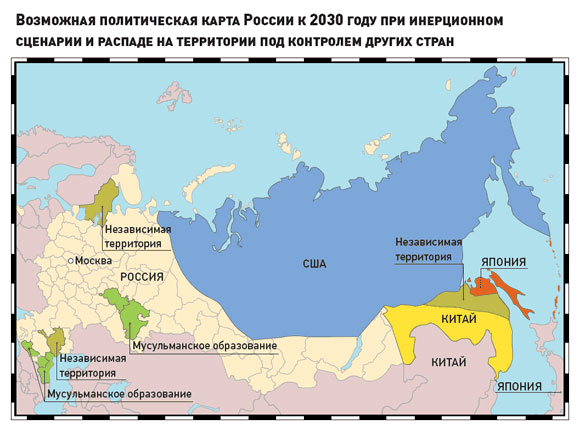
Let us imagine this scenario for a moment: everything works out for our foes, they have brought about a catastrophic weakening of Russia. But what is a weakened Russia? It is an economically degraded, impoverished, decaying country with a desperate, angry, embittered population. The question is: in which direction will the population turn, who will it heed, who will it follow? The pro-Western liberals, the democrats? There is no question of even talking about this, it is they who will be blamed for all the misfortunes, the potential support-base of Western ideological influence will be smashed to pieces. The Communists? Only partially, the baggage they carry from the Soviet era is just too unattractive. No, the people will follow the extreme nationalists, they will heed their xenophobic Nazi-tainted appeals. Hatred of the West, which "destroyed the Soviet Union and is now destroying Russia", will increase one-hundred-fold. The Nazis will not be able to break through into the real leadership of the country, but their influence on the ruling elite will increase to an enormous extent. But at the same time, no matter how weakened Russia might be and whatever pieces of it might fall off, Moscow will still retain the atomic and the hydrogen bomb. So you have a pretty picture: a poor, decaying country, seething with hatred for the West and all the "crappy democratic" countries there - but one with nuclear weapons. What could be worse for the West than such a scenario? And surely the West understands this, does it not?
They understand it very well, this very idea has been touched upon in many conversations. Tom Friedman of the New York Times wrote: "We do not fear a strong Russia, what is dangerous for us is a weak Russia, in which a missile could fall off the back of a truck and turn up somewhere in Iran". That is why Western diplomacy will, reluctantly and occasionally wincing, continue to do business with today's Russia, as the lesser of the possible evils. After all, is easy to imagine what horrific, truly apocalyptic consequences the disintegration of Russia could have, the emergence of new state e ntities that devour one another, the explosion of Islamist extremism in some of them, etc. The modern world, which is extremely agitated anyway, would turn into a nightmare.
"That would be good for the West," some people will say, "the Americans will be fishing in troubled waters, they will get rid of Russia as a competitor, and they will lay their hands on our natural resources." Here, it has to be said that there is little that can be compared in its absurdity to the argument that is often used about Russia being a competitor that must be finished off. What kind of a competitor are we, for goodness sake, and to whom? We export oil, gas and weapons - and there is enough room on the world market for everyone here. And in the most important sphere in the modern world, high-tech and knowledge-based production - where are we, in what place? When we have created Skolkovo, we will compete on an equal footing with America - so that will be when hell freezes over. And even if Russia were a serious competitor - so what? Look at China - it really is a competitor to everyone, the entire world is piled high with Chinese goods, but no-one intends to undermine, weaken or break up China.
The trouble for our apologists of fighting the West is that they are living with yesterday's realities, if not those of the day before yesterday, they do not understand how the world has changed. They still think there is nothing more important for the imperialists than, for example, seizing our Siberian oil. But any manager of a transnational oil company would have a heart attack as soon as he really imagined that he would have to deal with producing and transporting oil in the remote expanses of Russia. And seizing territories, establishing military bridgeheads - all of this is obsolete, like airships or gramophones.
The question then arises: why are all our hate-mongers, all the political scientists, journalists, and deputies "attached to the Kremlin" creating such an uproar? One of the explanations is understandable: the Soviet mentality is operating with its built-in mechanism that ensures the constant maintenance of the required level of anti-Americanism. What is amusing is that this anti-Americanism is for the most part affected and hypocritical. These people are now actually travelling to the West, they are prepared to fly off to America at the first invitation, their children study at British and American colleges, many of them have a lot of money in Western banks, and even real estate somewhere there. But when they return from their latest trip, they consider it their duty to "sling mud at" America, those are the rules of the game. Yes, and they get signals from above - saying there is nothing more useful for mobilizing the people around the party and the government than pedalling the external threat. And nobody thinks that this kind of game might be harmful within the country, for a population which is already clearly morally degraded. Xenophobia, inciting hatred towards "strangers", whether they are Caucasians or Americans, will inevitably lead to an increase in aggression and intolerance in society, which sociologists have long been sounding the alarm about. The "hardening of the hearts" of the younger generation is a threat not so much to the "Western enemy" as to Russian society itself.


10 comments:
We don't need Siberia. They just need to lay down their arms (S300s) and we'll bury them in Coke-a-Cola and low quality chocolate.
Also, Central Asia will become the 51st state.
You jest, but if you go to some post-Soviet countries you'll have people _asking_ you if the U.S. would please make them the 51st state.
Would they settle for being a temporary military lillypad?
Lyndon, I have some general questions about your posts (about the layout rather than the content.)
I might be confused or just an idiot, but are these reprints of other people's articles? There are no links to the originals. It's very difficult to tell what is yours and what is quoted material. Are the headlines yours? For example: "Pundit Sees Attempts to Incite Anti-Western Sentiment as Threat to Russia Itself" - was this the headline from Nezavisimaya Gazeta, or was, "Patriots' Fears -- West Not At All Interested in Weakening Russia?" What is the reference to the Institute of World Economy and International Relations?
Will you be adding your own analysis to these pieces? Or are you just doing those of us not signed up for JRL the service of reprinting the articles online? And as a blogger, what are the copyright guidelines for reprinting articles in their entirety and w/o links?
poemless, all good questions. I was thinking about doing an explanatory post about this, but answering your questions should take care of it.
In short, yes, I am being a lazy blogger and not generating much original content of late. When I reprint these translated articles from JRL (you are exactly right in speculating that I'm doing this for the purpose of making them available / linkable online in English, because JRL doesn't do that), there are no links in some cases because I have not troubled myself to find the link to the original Russian article. And there is no link for the "original" English version b/c it doesn't exist online, hence my posting the full text here. In some of these recent posts, I've added my own comments, always above the headline (which is taken from the JRL translation), and which I think are generally discernible because they are in italics or in the photo caption. The photos - and the broader availability of the English-language version - are my only real value-add on these posts :-)
Generally, of course, one doesn't and shouldn't reprint articles without links, however in this case there are no links to the English-language version. You're probably right in implying that I should take the time to find a link to the original Russian piece, if only to allow people to check the veracity of the translation. I used to do that pretty reliably, however in these last few posts I guess I've gotten extra-lazy. Thanks for calling me out.
I am not in a position to judge anyone for being a lazy blogger, and I appreciate having things brought to my attention. But the reason I care is one of attribution and citation. If I wanted to quote someone, for example, in one of the articles, I'd rather link to the original publication. Even if I am quoting them in English, I like to find the original and make sure I am (or the translator or reporter is) understanding them correctly, or at least let people decide for themselves. But especially if reprinting from a ridiculous members-only news group like JRL where I cannot even verify the source of the translation.
Also, it would be helpful if you could do something like:
The following article originally appeared in (name of publication w/link). The translation, printed here in full, originally appeared in JRL (w/date).
Headline
Byline
Body.
It might be obvious to you and the careful, daily reader what is yours and what is not, but I can see the casual reader scrolling past one or two lines and not knowing. Traditionally, the use of blockquotes or other formatting devices signifies words that are not those of the blogger, rather than the other way around.
Sorry - I don't intend to tell you how to blog - just letting you know I find it confusing.
You're right, of course, and the real solution is for me to spend more time having and writing down original (or at least derivative) thoughts. Your comments make me happy because they remind me of the need to do this and might perhaps motivate me toward action in that direction.
The reason I don't generally block-quote in these cases is because it seems weird to have the whole post (or 98% of it) block quoted. But maybe that's the solution. I am, of course, familiar with the blogosphere's conventions of citation, and they do exist for a reason. Watch this space for new and improved formatting.
And for what it's worth, I'm pretty sure JRL gets its English translations from some reasonable source - at any rate, when readers contribute translations to JRL (as I have done on some occasions), they are usually credited, so I assume these come from some (private or perhaps US gov't) press monitoring service.
Isn't it pretty sick that the JRL neither (a) links to the Russian web page nor (b) identifies the translator?
The JRL is an anachronism, almost wholly useless since it has no presence on the web to any significant extent. It has very little meritorious content, and when it does it is lost in the fog of email.
I don't find your post the least bit confusing Lyndon, and thanks for noting this, which I'll republish.
Nice article in the MT, too, BTW.
Oh and, just by the way Lyndon, don't forget that the person you are conversing with is a raving sociopath who works hard to justify totalitarian horror in Russia.
Hard to understand why latinos do not trust uncle Sam. Mexico lost only over half its territory, we are back to coup d'etats in the XXI century when everybody thought they were gone for good, Ecuador almost got it too, Guatemala was used in the 40's for nazi like experiments... the list could be long. And yes, nobody cares about the frozen expanses of Russia, least of all Uncle Sam. Well, you're going down because you guys figured you could fool the world the same way you fooled your own people.
Post a Comment