Thursday, April 24, 2008

Who Lost Russia? A rogues' gallery from a decade ago

Last February, I was inspired to collect a bunch of references from the past 10 years to westerners asking "who lost Russia?"

At the time, I promised a follow-up post, which has now been over a year in coming (no doubt you've all been waiting...). But since my original post, there's been a new twist on the question - last March, a WaPo columnist asked, "Who's to Blame for Russia?" - modifying the old "who lost Russia?" question by stirring in one of Russian philosophy's "eternal questions."

And the question came up in an interesting interview with Mark Medish:
(Konstandakopoulos) Who lost Russia?

(Medish) Russia may not have been lost. If it was lost in any sense of the word, it was lost by the Russians. Not from outside. I do not believe that those outside have the gift of losing countries. And this is the wrong way to think of the world. It is up to the Russians what to do with their country. If they feel themselves to be losers, it is because of their policies.

(Konstandakopoulos) I phrased the question in this way because this is how you traditionally do.

(Medish) US tradition teaches us how Americans think of the world, not how the world is. We go through cycles of high expectations and disappointments from other countries.

(Konstandakopoulos) A new cold war?

(Medish) I don't think so. There is no ideological component. Russia went through a transitional phase, it was quite weak, it sought a new identity after the collapse of the empire.

(Konstandakopoulos) What do you mean by transition? A transition to what?

(Medish) Good question. To begin with, a transition from something, from empire, from a communist-controlled political system, to something that they should decide. It is up to Russia whether to win or to lose. The ability of Europe and the United States to decide what the new Russian identity will be is extremely limited. We should not delude ourselves.
Actually, another variant on the question was posed last year as well: "Who Lost Moldova?" But I digress. The first anniversary of Yeltsin's death (which was yesterday, if I'm not mistaken) seems like a good time to revisit the 1990s. And an excellent vehicle for a trip back in time is a 1999 NYT Magazine article on the era, and specifically the illustrations to the article. Presumably, they are intended to depict people who, one way or another, were involved in "losing" Russia. I've listed the individuals pictured, in case you can't read the captions, and I tried to provide some links to bios in case you hadn't heard about some of these folks in the past few years.


David Lipton, Robert Rubin and Lawrence Summers; Anatoly Chubais; Boris Yeltsin and President Clinton; Tatyana Dyachenko.

Gennadi Zyuganov; Strobe Talbott and Viktor Chernomyrdin; Yegor Gaidar; Jeffrey Sachs.


Sergei Stepashin; Viktor Chernomyrdin and Vice President Gore; Vladimir Gusinsky; Boris Berezovsky.

Obviously one shouldn't attach too much meaning to the selection of photos, but it's interesting that the only guy who shows up twice, Chernomyrdin, still has a not unimportant job, and that Khodorkovsky did not merit placement in this photo array at all.

Wednesday, April 23, 2008

Why Putin is like Mugabe*

Zimbabwe's President Mugabe has been accusing his political opponents of intending to return farms to their dispossessed white owners.** Where have I seen similar populist rhetoric recently? Oh, right:


[image source]

The Nashi pamphlet this page comes from is an old story, but it is a good illustration of the Kremlin's main anti-Kasyanov talking point throughout the 07-08 election cycle - that he would surrender Russia's oil wealth to "the West" and take things back to the bad old days of the 1990s.

Here is a translation of the quotation attributed to Mikhail Kasyanov (under the banner headline, "This is what betrayal looks like"):
Having received the approval of American businessmen to enter the Russian presidential campaign, I have decided to sell Russian oil for three times less than the current market price.
And here is the actual quotation which appears to have served as the basis for the misquote above:
In his first interview with foreign media since announcing his candidacy, Mr Kasyanov said he would use the huge surplus from high oil prices to improve pipelines. He said: "Such projects would help lower the price of oil and gas on the market." A "fair price", he said, is $20-$25 a barrel. The price is now $63. "The world needs to think about alternative sources of energy, but use what we have now."
As Russian campaign spin goes, this is actually a pretty minor distortion, and no doubt Kasyanov would have been more accommodating, for example, to Western participants in the Sakhalin projects (in fact, one could argue that such accommodation would actually be in Russia's interest, since Western investment and know-how will likely be needed to maximize development of Russia's oil & gas sector). It's worth noting, though, that when Kasyanov was PM, he appeared to at least make a show of driving a hard bargain with Western investors in Russian oil projects.

Nevertheless, it served the Kremlin's interests to portray Kasyanov not only as the corrupt "Misha 2-percent" (a nickname acquired when two percent was enough of an alleged skim to seem offensive; never mind that the only proof of Kasyanov's corruption offered up to the public was a shady dacha privatization involving a sum which the barons of Rosneft and Gazprom would not bend down to pick up off the sidewalk on Tverskaya) but also as an agent of Western corporate interests. Similar nefarious intentions to forfeit Russia's oil wealth were ascribed to Vladimir Ryzhkov (apparently solely on the basis of a meeting with Dick Cheney).

Of course, the myth-making about Russian traitors would be nothing without the creation of a parallel mythology of Western politicos salivating at the prospect of carving Russia up and feasting on the oil wealth. Exhibit A in that book of fairy-tales is the infamous false claim that Madeleine Albright once stated Russia was unworthy of Siberia's oil wealth.

Unlike Zimbabwe, Russia is not a former colony of the West and has never been in danger of losing control of its natural resources. Apparently, Putin & Co. realized that the rhetoric of xenophobia and class hatred travels well to any country.

* Presumably one could fill many blog posts with why Putin is unlike Mugabe. I know almost nothing about domestic politics in African nations, so I would be on shaky ground trying to write such posts (as indeed I may be in trying to draw the comparison which provides the lede for this post). If you feel strongly about the distinctions, feel free to sketch out such posts in the comment section. Let me begin: Putin almost undoubtedly has more genuine popularity in his country than Mugabe does in his; on the other hand, Mugabe's political opponents seem to have actually made it on the ballot, an indignity which Putin refused to suffer.

** For all I know, this may be a valid accusation. My guess, however, is that Mugabe is attempting to spin a more conciliatory stance on the part of the opposition toward the farmers into some sort of treacherous behavior which goes against the interests of the state.

Tuesday, April 22, 2008

From the TASS photobank


Creation Date: 2001/10/15
Title Rus: Резервисты, мобилизованные в абхазскую армию, едут на боевую позицию, где идет бой с бандой Руслана Гелаева.
Title ENG: Reservist soldiers are called up to Abkhaz Army to take part in action against Ruslan Gelayev's gang.
Caption: TAS25: ABKHAZIA. OCTOBER 15. A car transports reservist soldiers to combat positions at the bottom of mountain Sakharnaya Golova (Sugar Head). The reservists were called up to Abkhaz Army to take part in action against Ruslan Gelayev's gang, which penetrated to Abkhazia from Chechnya. (Photo ITAR-TASS / Viktor Klyushkin)

The Political Technologist from the Left... and from the Right

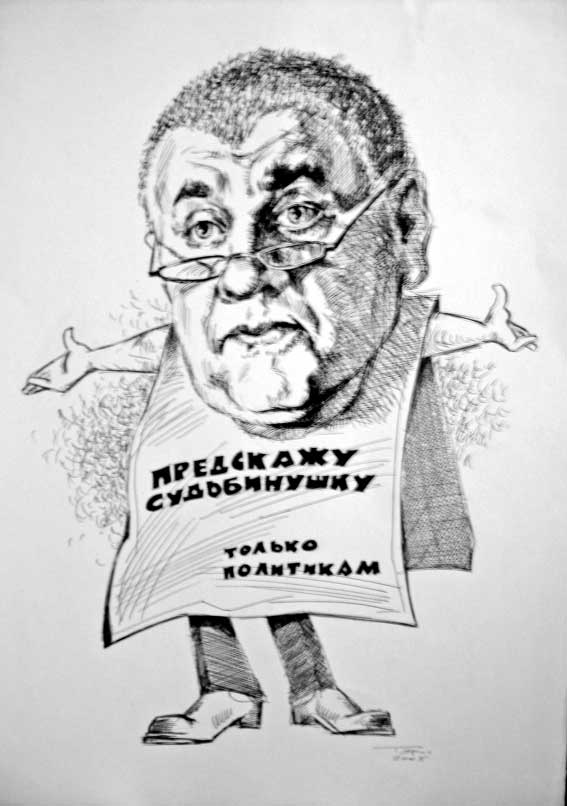
Gleb Pavlovsky: "Fortunes told - politicians only" - image source.

Below are a excerpts from a couple of things I've read recently which address the role of "political technologists" in contemporary Russian politics. In order to save space, I have not indented the excerpts; hopefully it's clear where they begin and end.

Pavlovsky from the Left


Глеб Павловский.Фото Натальи Преображенской (НГ-фото)

From: Chto delat
Date: Mon, 01 Feb 2008 12:50:32
To: [Alain Badiou]
Subject: Lettre des activistes russes concernant votre prochaine visite en Russie

Dear Comrade Badiou!

We are Russian activists and leftist intellectuals. We know and value you as a philosopher and intellectual who has not surrendered in the face of the current neo-capitalist reaction. In your public statements, you have on many occasions expressed your allegiance to the great contemporary liberation movement, of which we also consider ourselves to be a part. [...] [I]t has come to our attention that Gleb Pavlovsky’s foundation (The Russian Institute is a branch of this foundation) has invited you to visit Moscow this coming April. This news dumbfounded those of us here who know and appreciate your work and your political stance. We have long dreamed that you would visit us in Russia. But a visit under these circumstances would be worse than no visit at all. It would compromise you and us, your readers and supporters.

What is at issue is the person of Mr. Pavlovsky, who is not only one of the principal ideologues of the Putin group, but is also a cynical “political technologist” who several times switched his political orientation during the nineties. He has now settled on an ultra-rightist version of nationalist and imperialist conservatism, and is busy erecting the Putin personality cult. You might wonder why he decided to invite you of all people. The answer, however, is obvious: the Russian regime has decided, on the ideological level, to develop a new strain of anti-westernism based on Russian nationalism.

This is motivated, in part, by the real imperialist pressure exerted on Russia by the EU and the US; in part, by the discomfort that liberal demands to observe human rights and legality in general creates for the regime. Therefore, Putin and his ideologues have an objective interest in recruiting western oppositionist intellectuals to an international front that would support them. At the same time, it must be understood that Putin is no Chavez. As opposed to the latter, Putin and his ideologues systematically anchor their appeal in rightist values: nation, order, the fear of revolution, Russian Orthodoxy, cultural anti-modernism, etc.

[. . .]

Gleb Pavlovsky is one of a number of notable intellectuals who chose the career of “political technologist” in the nineties. During the crisis in the universities and the intellectual vacuum that formed after the discrediting of Marxism, many members of the intelligentsia chose to engage in paid PR work, motivating their choice via a combination of watered-down postmodernism and social constructivism. As they would put it, all meanings are artificially produced.

In 1996, Pavlovsky — who was a dissident in Soviet times and an active liberal during perestroika — became the principal beneficiary of the Kremlin’s ideological commissions. In the early years of the new millennium, he became even more powerful when his foundation, The Foundation for Effective Politics, engaged in the propaganda and informational support of the Putin administration. It is this foundation that developed the fundamental ideologemes of the regime: “stability,” “the Putin majority,” etc.

Whereas in the nineties Pavlovsky justified himself in the postmodernist spirit, as we have mentioned, in the new decade he has become a frank collaborationist and a businessman trading in propaganda, exploiting the impoverished social and economic status of Russian intellectuals and thus turning them into cynical servants of power. At present, Pavlovsky hosts the television program Real Politics, on which he propagandizes extreme anti-westernism and the Putin personality cult. He also manages the Evropa publishing imprint, which among other thing has issued a series of books exposing the idea and phenomenon of revolution. Recently, Pavlovsky organized a roundtable entitled “Putin’s Enemies”—a farce that made open reference to the Stalinist show trials.

Dear Comrade Badiou! We have no doubt that your visit will be used by Pavlovsky to legitimize the Kremlin, which aspires, mostly unsuccessfully, to intellectual hegemony. In the spring of 2007, Pavlovsky’s foundation invited Slavoj Žižek to Moscow. It is conceivable that this leftist thinker didn’t know beforehand the context in which he would be speaking. In the event, however, he participated in a seminar entitled “The Limits of Democracy” and sat at the same table with court “political scientist” Sergei Markov, who as a television commentator praises the wisdom of Putin’s decisions, and with Pavlovsky himself, who doesn’t himself believe a single word he utters. Pavlovsky and Markov spoke about the need to “limit” democracy, in the sense of Putin’s “managed democracy.” It all resembled a bad comedy and forever discredited Žižek in the eyes of Russian (leftist or liberal) intellectuals. If you do visit Russia, this context will hinder any attempt on your part to polemicize and discuss the views of those who have invited you.

We do not mean to say that Russia is lost for good, or that it is of no interest. Russian society is still lively, anarchic, critical, highly educated, and intellectually hungry. It possesses the will to transformation and a consciousness of the need for struggle. At the present moment there is a growing network of organizations and groups that, we hope, will consolidate into a new anti-liberal, communist movement. For this to happen we also need international cooperation. In particular, we take as a guide your ideas, whose universalism impresses us, dwellers of the semi-periphery. We would like to engage you in conversation. But your visit to Pavlovsky would disenchant many activists. We ask you, therefore, to weigh your decision again.

[...]

Chto Delat/What Is To Be Done Platform
Forward Socialist Movement
Pyotr Alexeev Resistance Movement
Carine Clément (Institute for Collective Action)


From: Alain Badiou
Date: Mon, 04 Feb 2008 16:42:47 +0100
To: Chto delat
Subject: Re: Lettre des activistes russes concernant votre prochaine visite
en Russie
Dear Comrades,

I thank you for your serious and well-argued warning. I have just returned from Greece and I will have to examine your arguments in more detail. They already seem quite strong to me. I will notify you of my decision in the coming days. If you believe that there is a real possibility of my coming to Leningrad, then we can go this route. I thank you again for your vigilance. And be assured that I have no wish to serve Putin’s interests!
Fraternal greetings,

Alain Badiou
4 February 2008

* * * * *
In his last letter, dated 17 February 2008, Alain Badiou informed us that he had turned down Pavlovsky’s invitation to visit Moscow and that he planned to come to Russia in the spring of 2009.


Note that the guys at Chto Delat' also had good coverage of the MGU Sociology Dept controversy, a subject which we at Scraps of Moscow had occasion to cover last year and which remains interesting, not least because of the possibility that it was that controversy that first put exiled journalist Natalia Morar' on the Kremlin's radar.


Pavlovsky from the Right

Картинка 2 из 632

The other article I wanted to highlight is one which is worth reading in its entirety if you are interested in contemporary Russian domestic politics. Some of the more insightful passages are excerpted below. I have added my own links to outside sources where appropriate, replaced footnotes in the original with hyperlinks and omitted citations from the original where it was impossible to hyperlink them.

Ivan Krastev, Democracy's "Doubles"
Journal of Democracy, April 2006

Ivan Krastev is chairman of the Centre for Liberal Strategies in Sofia, Bulgaria, and the editor-in-chief of the Bulgarian edition of Foreign Policy. He is also the research director of a project on “The Politics of Anti-Americanisms” coordinated by the Central European University in Budapest. [...]

If I were to choose the two major protagonists of the new antidemocratic politics, I would put alongside Hugo Chávez not Vladimir Putin but Gleb Pavlovsky, Russia’s premier political technologist. Admittedly, Pavlovsky and Chávez make a strange pair. The latter is a passionate former army officer, with a talent for expressing public sentiments, who loves elections even more than coups and spends his free time running a television show. [...]

Pavlovsky, by contrast, is an intellectual with a talent for manipulation and political engineering. Far from loving crowds, he fears them—though he also recently started a TV talk show. These two men — Hugo Chávez, Venezuela’s populist president, and Gleb Pavlovsky, Russia’s ultimate political manipulator — best symbolize the major challenge to democracy today. They are freedom’s enemies from
within both democratic discourse and the institutional framework of democracy. The ex-colonel and the political technologist are the faces of the antiliberal doubles of democracy.

Democracy According to the Political Technologists

In a Kremlin world dominated by mediocre apparatchiks, KGB officers, and ruthless oligarchs, the political technologists might look like people from another planet. They come from the milieu of the intelligentsia and the world of alternative culture. Gleb Pavlovsky is a policy intellectual and a former dissident who was persecuted in Soviet times for his “reformist delusions.” Marat Gelman is an extremely successful art-collector and gallery owner and one of the gurus of the Moscow arts community. Sergei Markov is an internationally respected academic. They all have the biographies of typical Russian Westernizers. Pavlovsky worked with George Soros and his Open Society Institute in the early 1990s and briefly acted as editor of a Russian version of the
Journal of Democracy. Markov was a fellow in the Moscow office of the Carnegie Endowment for International Peace and coauthored a book with Michael McFaul [the book is ironically titled The Troubled Birth of Russian Democracy and is available on Google Books]. Gelman was a favorite source for Western journalists working in Moscow. They were Russia’s liberals. In the early 1990s, they proclaimed their belief in free and fair elections, limited government, democratic pluralism, and independent media. Today, however, they have all become “political technologists.”

In his scandalous political thriller The Politologist, written in the best tradition of conspiratorial realism, Alexander Prohanov, a leader of Russia’s patriotic opposition, gives us the most sinister and at the same time most profound psychological portrait of the Russian political technologist. He is a creature from hell: cynical, disloyal, ambitious, and greedy. He is highly creative and deceptive at the same time. He is the hostage of his ambition to manipulate others. He is the consummate social engineer, but also a tool of Kremlin politics. He is a tragic figure — confused, scared, and insecure. In his own view, the political technologist is the savior of democracy in Russia; in the view of others, he is its gravedigger.

In Moscow, the way you define the meaning of “political technologist” is a significant indicator of your political positions and moral taste: “Political technologist” can mean a policy analyst or political consultant; it can mean an expert in “black PR” or in contaminating the political environment; it can mean a Kremlin insider or political provocateur. Contrary to the common view of the Western media, “political technologist” is not simply the Russian term for “spin doctor.” What makes political technologists a different species from the other election strategists or PR consultants who have populated the strange world of Russian politics is their direct or indirect connection to the Kremlin. The Russian political technologist resembles a Western political consultant in the way that the electric chair resembles an armchair.

Political consultants in the West (however low one’s opinion of them) work with independent media, and their trade is influencing these media. Political technologists are experts in manipulating dependent media. Political consultants in the West are experts at winning votes for their candidates; political technologists are also specialists in winning votes, but they take matters one step further—they are also specialists in “creative counting” of the votes. A political consultant works for one of the parties in an election and does his best to help that party win; the political technologist is not interested in the victory of his party but in the victory of “the system.” His goal is not to maximize the vote for his client, but to obtain an election result as close as possible to the percentage of the vote that the Kremlin has planned for his client.

In other words, political technologists are those in charge of maintaining the illusion of competitiveness in Russian politics. As Andrew Wilson puts it, “Post-Soviet political technologists . . . see themselves as political metaprogrammers, system designers, decision-makers and controllers all in one, applying whatever technology they can to the construction of politics as a whole.” Their role in Russian politics recalls that of Gosplan in the Soviet economy. They are the ideologues and the symbol of Russian managed democracy. They operate in a “world of ‘clones’ and ‘doubles’; of ‘administrative resources,’ ‘active measures,’ and ‘kompromat’ [compromising information]; of parties that stand in elections but have no staff or membership or office . . . of well paid insiders that stand as the regime’s most vociferous opponents; and of scarecrow nationalists and fake coups.” [fn 6] Political technologists are the principal enemy of democratic pluralism.

Political technologists play several different institutional roles at one and the same time. They run think tanks and speak as experts on behalf of the public good. They are also consultants who speak the language of business and deny any political affiliation with their various clients; this does not prevent them, however, from also presenting themselves as independent political commentators who interpret for the public what is going on in Russian and global politics. When it becomes necessary, the political technologist, as a sacrifice of last resort, is even ready to take a public job. In 2003, just before the parliamentary elections, Marat Gelman was appointed as deputy director of the public television station ORT-Russia to help ensure that political parties would gain the electoral results that were planned for them. In the wake of the Orange Revolution in Ukraine, Modest Kolerov, Pavlovsky’s deputy at the Center for Effective Policies, joined the presidential administration as head of the new “anti-Orange” department dealing with the post-Soviet republics. The political technologist can be found everywhere in the policy process, performing all kinds of jobs. In his role as “gray cardinal,” Pavlovsky urged the Kremlin to adopt new legislation that would create a body known as the Public Chamber in order to control Russia’s NGOs. In his role as a policy expert he supported the move, and then in his role as an independent political commentator he explained to the public what a wonderful policy the Kremlin had initiated. The circle was closed.

Those who question the real importance of political technologists, contending that they are less influential in Kremlin decision making than the siloviki or the in-house oligarchs, fail to recognize that the political technologists’ impact is greatest in framing political issues and not in lobbying for concrete policies. In this sense, the political technologists can be analyzed as a collective player in Russian politics, despite the fact that in real life political technologists constantly compete with and often passionately hate one another. It is their shared view of the nature and the goals of current Russian politics that makes the political technologists so revealing with regard to the nature of the political regime in Moscow. Their interest is the interest of the system.

Manipulating the Media

The type of political regime that governs Russia today would have been unthinkable in the pre-television age. The art of the political technologists lies in replacing the political representation of values, interests, and ideas that is at the heart of liberal democracy with the media representation of a nonexisting political reality that is at the core of managed democracy. Their ideology is a Molotov cocktail of French postmodernism and KGB instrumentalism. What the political technologists have borrowed from the postmodernists is their intuition of “the unreality of reality.” What they borrowed from the rich tradition of the Soviet secret police were the technologies that can make the unreal real. The role of television and m in establishing managed democracy in the post-Soviet states is perhaps best captured by a poster that one Ukrainian youth carried in the streets of Kiev during the Orange Revolution in late 2004. The poster read: “Kill the TV in yourself.” [interestingly, this later became a rallying cry for the nationalist Eurasian Youth Union as well]


A common thread in the otherwise diverse ideological views of people like Gleb Pavlovsky, Marat Gelman, and Sergei Markov is their militant antirevolutionism and their self-proclaimed break with the traditional politics of the Russian intelligentsia. In Pavlovsky’s words, “Our position on revolution is simple: no revolutions and no encouragement of revolutions.” The demonstrative cynicism of the political technologists is intended as a direct challenge to the idealism of the Russian revolutionary intelligentsia at the beginning of the last century. Their open ambition for money and status is the opposite of the culture of self-sacrifice and the attachment to nonmaterial values of the old Russian intelligentsia. Their project of excluding the people from political life runs directly contrary to the old intelligentsia’s mission of giving power to the people.

The political technologists believe that their mission is to save democracy from the antidemocratic impulse of those on top and from the populist egalitarianism and communist nostalgia of those below. For them the government is the only real liberal force in Russia. In their eyes, “Liberal democracy is nothing more than a mechanism of elite control through the use of elections, parties . . . and most importantly, ‘the independent media.’” They have fashioned themselves as the postliberal postintelligentsia.

[...]

In hindsight, two events appear to have been critical in shaping the emergence of Russia’s managed democracy: Yeltsin’s bombardment of the Russian parliament building in October 1993 and his victory in the presidential election of June 1996. The attack on parliament convinced the elites of the undesirability and limited effectiveness of violence. The reelection campaign convinced them of the power and effectiveness of manipulation. Managed democracy was justified as the best way to prevent a communist restoration. For this reason, it appealed not only to some Russian liberals but also to Western governments, whose greatest fear was that Yeltsin would be defeated by the Communists. The establishment of managed democracy in Russia would never have been possible without the endorsement of the West. It was the decision of Western governments to endorse Yeltsin and not to insist on fair elections that brought to life the current regime in Russia.

Read the whole article here.

Saturday, April 19, 2008

Another Good Read

The image “http://www.lindsayfincher.com/gallery/d/12906-2/chernobyl_pripyat_amusement_park_bumper_cars.jpg” cannot be displayed, because it contains errors.

From the Kennan Institute's 2006-07 Annual Report:
DIRECTOR'S REVIEW: Bumper Cars and Demolition Derby
Blair Ruble, Oct. 1, 2007


[...] Ukraine and Russia have been on different trajectories for some time, presenting an ideal setting for comparative social science research. Ukraine is a country visibly divided by fractures and fissures which run through the entire social landscape. Politicians are like bumper cars, clumsily careening toward one another in an amusement park before bouncing off more or less unharmed only to come crashing together yet again. Society sorts out its own coping mechanisms every day on the streets so as not to allow divisions to overshadow an increasingly good life.

Russian politics, on the other hand, resemble the American automobile sport of demolition derby, in which drivers of old, beat-up cars viciously crash together with increasing violence until only one victor is left to ramble around the field. The good life in Russia seems reserved for the strong.

Russian reality is more complex than its ever-more controlled political life might suggest, with very real divisions and contrasts existing across the sprawling Russian Federation. The social science question posed by contemporary Russia is more difficult than that presented by contemporary Ukraine. Ukraine’s complexities are open for all to see. Russia’s contradictions are hidden behind layers of obfuscation. No observers mistake Ukraine for the Soviet Union; analysts talk and write about the return of Soviet political practices in Russia every day. This perspective—which, at times, appears to be shared by the Russian political class—is misplaced. [...]
Read the whole article.

Tuesday, April 08, 2008

Good read


LJ blogger drugoi titled his post with this photo "V for Vendetta,"
although the content of the post was laconic - "Putin in Bucharest."
A photographer who is spare with his words, drugoi is one of my favorite Russian bloggers. And I'm not the only one. The post with this photo has 153 comments, and I'm surprised it's so few - often his posts of photos with political (or politicized) subjects collect hundreds of comments.


I really enjoyed today's Moscow Times column (re-run by Russia Profile, where it will be viewable longer) by Alexander Golts (his Ezhednevny Zhurnal columns are here). Although it's brutal, I found it to be articulately brutal, if such a thing is possible, and dead-on in many respects. And it rather strangely fails to mention Georgia or Ukraine - critics of Golts's view will say this proves his one-sidedness (they'll also point out that he spent a year at Stanford, which no doubt entitles him to a lifetime of being assumed to be a US agent), but there are arguments he could have made (NATO already borders Russia; those two countries aren't going to actually be members anytime soon; etc.), and it's too bad he didn't bother.

He does, I think, a good job of describing a scenario which takes place around the world in countries other than Russia - a US "threat" is ginned up to mobilize popular support for a leader who is actually concerned about other matters entirely:

Moscow Times
April 8, 2008
West's Criticism, Not NATO, Worries Putin
By Alexander Golts

Imagine that a person decides to pose as a 19th-century Russian nobleman. He wears a long coat, walks with a cane and lets his sideburns grow long. He would suffer no serious consequences from his behavior other than the occasional shake of the head by passers-by. But now imagine that this would-be nobleman challenges others to duels at the slightest provocation and claims that the passers-by are his former serfs. At best, people would try to avoid him. At worst, they would beat him.

Something like this happened to President Vladimir Putin at the NATO summit in Bucharest, Romania, last week.

At a security conference in Munich last year, Putin caused a scandal by suggesting that he looked at world events through Cold War eyes. He not only demanded nuclear parity with the United States but asserted that the placement of 10 U.S. missiles in Poland threatened Russia's 3,500 nuclear warheads. He further declared that NATO's eastward expansion represented a military threat to Russia.

Actually, Putin was far from being worried about a military threat from the West. At the time, he was deeply anxious about whether the West would accept the legitimacy of his plan to hand the presidency to his chosen successor. During that politically difficult period, Putin tried to engage his Western counterparts in a squabble about missiles, as world leaders did back in the 1980s.

Now that this critical period has passed, U.S. Secretary of State Condoleezza Rice and Defense Secretary Robert Gates lavished compliments on President-elect Dmitry Medvedev after meeting him last month, and Putin has noticeably toned down his rhetoric. [...]

vesti.ru


It isn't a NATO military threat that is galling the Kremlin. Moscow is angry that no matter how polite Western officials try to be, they still believe that the democracy of Putin's government is not on a par with their own. The West considers Ukraine to be a democracy, but not Russia. In a news conference at which he tried to refute the argument that an expansion of NATO was the equivalent to an expansion of democracy, Putin said, "If this or that country is a NATO member, it claims to be a democracy. But if a country is not [a member of NATO] -- that means it is not a democracy? What kind of drivel is that?"

It is true that from Putin's point of view it must be either drivel or an outright falsehood for a country's candidacy to join a military alliance to be based on the presence of strong democratic institutions rather than the number of troop divisions and warheads it has.

In the end, there is no getting away from the idea that this "values gap" renders futile any attempt to lay a solid foundation on Russia's relationship with the West. In the absence of common values, relationships are formed in the manner of 19th-century German leader Otto von Bismarck, who was more concerned with a country's military potential than its perceived intentions. This is why Putin lives in constant anticipation that the West will play a dirty trick on him, why he cannot honestly formulate the reason for his irritation, and why he is unable to verbalize the rationale behind his never-ending and senseless rants about the Western military threat to Russia.

U.S. President George W. Bush showed greater flexibility than he has in the past by choosing not to leave office on a note of conflict with Moscow. In Sochi on Sunday, Russia and the United States produced a fairly pointless document titled a Declaration of the Strategic Framework of Russian-American Relations. It is amusing that in the opening lines of the document both sides hurry to convey the same thing they declared 28 years ago -- namely, that the relationship between the two sides was not confrontational in character. Putin unexpectedly declared that he felt a guarded optimism about the possibility of reaching an agreement over missile defense.

The real cause for Putin's satisfaction, however, was that Bush affirmed the legitimacy of Medvedev as Putin's successor. And this is why Putin can shelve the threat of more Cold War rhetoric -- until it is needed again.

Read the whole article here.

Sunday, April 06, 2008

Tragedy and Tragicomedy

Today we went to see Rigoletto at the Kennedy Center. When a story ends with a guy standing over the body of his daughter - who is dead as an unintended result of a chain of events he set in motion - and crying out "Ah, the curse!" that's tragedy. The final stage direction in the libretto is, "Tearing his hair in anguish, he falls senseless upon his daughter's body." Wow.

But happily in real life one often encounters situations with elements of tragedy but which are also amusing in some way. Here are some excerpts I translated from a message Lorina received from an old classmate from her school days in Moldova (they reconnected - where else - on odnoklassniki.ru, the Russophone world's answer to MySpace and Classmates.com (I would say Facebook, but vkontakte is the true Russophone Facebook clone)) - she had asked about a mutual friend of theirs:
Hi. I'm glad you remembered me. I live in Kiev now. I've been married four times. I don't know where [N**] is, but his parents told me he's living in Moscow, he married a Muscovite, they showed me pictures of her. [N**] probably wanted to get Moscow registration papers and that's why he got married there. When I saw the pictures of his wife they freaked me out - she's ugly. I didn't think [N**] would have such an ugly wife. I thought he would marry a model. My second wife was a model, the third one was Greek, but I got deported from Greece. Now I live in Ukraine. [...]

I didn't think that you would leave for America. I visited Los Angeles, and I didn't like it there. Americans are crafty bastards and mean [хитрожопые и злые]. In American movies they're awesome, but in real life they're idiots. [...]

Friday, April 04, 2008

The lighter side of secessionism

There has been plenty of serious discussion from all quarters - not to mention overblown posturing from some - about Kosovo's declaration of independence. Heck, even here at Scraps of Moscow I have been unable to resist posting on the subject from time to time (though not because it should necessarily have any relevance or precedential value for the resolution of the other unresolved conflicts). But there is also a lighter side to the struggle of unrecognized states, de facto states, microstates and other secessionist entities for legitimacy.

For example, shortly after Kosovo's "UDI," snarky DC gossip site Wonkette - in a tongue-in-cheek style which was intended to ape American provincialism but really just confirms a sort of knowing indifference which may be worse than ignorance - posted a rundown of the other spots on the globe vying to be next:

The Foreigns Present: Your Guide To The Hellholes

Those crazy Kosovars! Their little declaration of independence has caused quite the shitstorm — not just among the great powers who are wrangling over whether to recognize them or not, but among the world’s other pissant quasi-countries, who are mad that they didn’t get to do it first....This week, The Foreigns will take you on a tour of the world’s saddest unrecognized not-countries.
The territories profiled were "TRANSNISTRIA: Come for the heroin, stay for the whores"; "NORTHERN CYPRUS: Maybe this 'independence' thing wasn’t such a hot idea"; "SOMALILAND: Proving that 'hellhole' is a relative term"; "ABKHAZIA AND SOUTH OSSETIA: Sometimes pawns are just happy to be in the game"; and "WESTERN SAHARA FREE ZONE: Sand, sand sand!"

The highlights of the comments section:
Bill Clinton: "Transnistria? I think I caught that from a New Orleans hooker once."
And:

"because nothing could possibly go wrong for you when your enormous neighbor is playing games with your sovereignty for its own larger geopolitical purposes!"

Huh. I have that EXACT phrase on my license plate holder.

But the real impetus for this rundown was not a month-and-a-half-old Wonkette post. No, it was my good fortune in happening upon a hilarious episode of Family Guy entitled E Peterbus Unum. Here is Wikipedia's plot synopsis:
Peter declares his house to be the new microstate of "Petoria." He spends a night in Quahog insulting Horace (at The Druken Clan) and bringing beer out into the streets, stepping on grass that can't be touched, and violating numerous laws such as littering, sexual harassment, and vandalism. He flaunts his diplomatic immunity by singing a parody of MC Hammer's song "U Can't Touch This" and mentions that he can’t be sued by Hammer.

Snubbed at the United Nations, Peter follows the advice of a diplomat from Iraq and annexes Joe's pool, calling it "Joe-hio." Days later, when Chris tries to go to school, he is turned away because the US Army surrounds and blockades the nation of Petoria with tanks and missiles as part of "Operation: Desert Clam." Further, all electricity and water has been cut and Lois home schools the kids.
Sadly, this is not one of the few Family Guy episodes that have been made available on the TV companies' new video site Hulu. But you can watch MC Hammer parody, "U Can't Touch Me," on YouTube, at least for now:


The idea of being "untouchable" - more commonly known as immunity - as well as a general bad-ass complex, seems like it could be common among the leaders of would-be states. The Family Guy parody calls to mind a story I heard from someone who'd had occasion to meet with Igor Smirnov, the de facto leader of Transnistria. Apparently Smirnov keeps a safe full of gold coins in his office, and when he wants to convince his interlocutor of the fact that he is both independent of Russia and not susceptible to Western inducements, he shows off his hoard.

The last bit of comic relief I wanted to share is about Kosovo, from a Wall Street Journal article last week:
Freedom's Ring: Kosovo Covets A Dialing Code

By CHRISTOPHER RHOADS
March 27, 2008; Page A1

Kosovo, which a month ago declared independence from Serbia, is working on a constitution. One problem: On the front page of the latest draft, the government phone number is Serbian.

....Kosovo has a problem, because it isn't a member of the U.N., and only countries that are can get their own dialing codes. So, land-line calls into Kosovo still must use the exchange, +381, of a group that many Kosovars detest: the Serbs.

"Every country's independence rests on certain pillars," says Anton Berisha, chief telecom regulator of Kosovo, a land of two million a little larger than Delaware. "One of them is a country dialing code."

Matters so mundane aren't usually considered the stuff of patriotic fervor. But in Kosovo during the past tumultuous decade, the battle for telephone autonomy has led to the ouster of the head of a telecom company, the dismantling of cell towers built by a Serbian company and two assassination attempts, one using a rocket launcher.


"I was not prepared for this kind of debate," says Mr. Berisha, the target of both attacks, which occurred last year. He now travels only with police escort.

In fact, dialing codes have figured in nationalist movements before, from the Palestinian territories and Taiwan to Catalonia and Sudan. "Even if it doesn't make sense, people are attaching more weight to having a dialing code," says Richard Hill, whose duties include distributing dialing codes as an official at a U.N. body in Geneva, the International Telecommunication Union, or ITU.

For those of a nationalistic bent, Mr. Hill says, a dialing code can be as meaningful as a flag, a national anthem or a team in the Olympics. He declines to comment on the Kosovo situation.

Without permission from the ITU, the Palestinian phone company has struck agreements with phone companies in sympathetic Arab countries to connect calls through the Palestinian company's unofficial code, +970. Previously, calls to the Palestinian territories connected only through the Israeli dialing code, +972, which is still used by callers from many Western countries.

As for Taiwan, as it emerged as an economic power in the 1980s, it began using an unassigned calling code, +886. Taiwan, too, persuaded some foreign phone companies to send along calls with the number it preferred. The move defied China, which has long claimed Taiwan and had assigned it a regional phone prefix as a Chinese province. After years of negotiations, the ITU in 2006 officially assigned the +886 exchange to Taiwan, while still listing the island as part of China.

Foreign Exchange

Dialing codes carried little of this political baggage in the late 1950s and early 1960s, when they first grew in use and became standardized, according to Mark Cuccia, a retired library worker in Lafayette, La., who tracks phone numbers as a hobby. Creating a single list of dialing codes made it easier for international operators to connect calls, since countries often had unique phone systems.

In the 1990s, political events turned dialing codes "into a big phenomenon," Mr. Cuccia says.

The fall of the Berlin Wall in 1989 and disintegration of Yugoslavia in the early '90s led to a scramble for dialing codes by new states eager to underscore their independence. Tiny European states like Andorra and Liechtenstein, which had long shared the dialing codes of their bigger neighbors, felt compelled to get their own codes, too. Just last year, Montenegro, a former Yugoslav republic that's now independent, was granted +382.

The struggle for a Kosovo dialing code dates to as early as 1999. Bombing led by the North Atlantic Treaty Organization had just expelled Serb forces from Kosovo -- then a Serbian province -- and placed Kosovo under U.N. supervision.

The U.N. mission ousted the head of the Kosovo telecom operator after he bitterly opposed awarding a mobile-phone license to Monaco Telecom. His problem: Although the Monaco company had essential international roaming agreements, using the company would mean using Monaco's dialing code.

The disgruntled chief of the local telecom operator, which is called PTK, had wanted a bidder with no dialing code, so he could agitate for Kosovo's own code. But, a U.N. official told reporters at the time, PTK needed a solution that "would actually allow people to make phone calls."

Monaco Telecom began to charge PTK tens of millions of dollars in annual fees to handle Kosovar wireless calls. The deal meant that people abroad who called a cellphone user in Kosovo had to use Monaco's +377 exchange.

But that was still better than using a Serbian carrier, in the eyes of many ethnic Albanians, who are about 90% of Kosovo's population. Ethnic Serbs in Kosovo, most of whom live near the border with Serbia, can pick up signals from a Serbian carrier.

In 2005, a Kosovar delegation visited the ITU in Geneva to argue that Kosovo should get its own code, says Etrur Rrustemaj, a PTK official in the delegation who later served as chief executive officer of PTK.

Unsuccessful, Mr. Rrustemaj turned his attention instead to dismantling antennas installed by a Serbian wireless carrier in the Kosovo capital of Pristina, including one atop a PTK building.

He was careful not to destroy the antennas, just unplug them. "If I took them down, I'd be in jail for attacking minorities," he says.

In February of last year, after a muddled bidding process for Kosovo's second mobile-phone license, Kosovo declared the winner to be Slovenia Telekom. Mr. Berisha, the telecom regulator who oversaw the auction, had to consider foreign bidders, since Kosovo doesn't have its own dialing code.

Bullets Fly

One morning later that month, Mr. Berisha was riding in a car to work with his aunt and her daughter when gunmen emerged from the side of the road and opened fire on their car. No one was injured.

Just six weeks later, Mr. Berisha, by then commuting in a police vehicle with two armed officers, was attacked again. This time, one of the gunmen launched a rocket at the car. It didn't explode properly, and injured only the driver, he says.

One of the alleged attackers, later arrested, turned out to be an official of PTK, the local telecom operator. Mr. Berisha believes his attackers were upset that he had awarded a mobile-phone license to a Slovenian operator and at the prospect of new competition.

The solution, for nationalists who yearn for a Kosovo dialing code, would be U.N. recognition of Kosovo as an independent nation. But while the U.S. and more than 30 other countries recognize Kosovo's newly declared independence, U.N. membership is far from assured. Russia, which has a veto as a permanent Security Council member, has vowed to block it.

"We are forced to work with these mixed country codes, which has made our lives more difficult," says Mr. Berisha.

Wednesday, April 02, 2008

The Russophobia Scarecrow

My comments on a commentary piece from today's Moscow Times:
The Russophobia Card
by Andrei Tsygankov
Moscow Times, April 3, 2008

The U.S. presidential candidates are increasingly playing the Russophobia card in their campaigns. In addressing Russia, Senators John McCain and Hillary Clinton have resorted to insulting President Vladimir Putin as a KGB spy who has no soul.
The first mistake in the column is an understandable but important one - substituting Putin for Russia. As Anders Aslund has recently noted, taking a dim view of the former does not have to mean one has given up hope for the latter.

After all, the harsh criticism to which Tsygankov refers has been chiefly of Putin and his signature style - and is it really surprising that individuals who are vying for the votes of American citizens would criticize someone who has sought to score political points internationally and at home by employing anti-American rhetoric? Furthermore, while McCain's criticism of Russia has been something of a minor campaign theme, one can discount this at least a bit if one recalls that one of McCain's main goals at this stage is to differentiate his approach to the world from George Bush's in the eyes of the voters. As for the implication that Hillary has been "increasingly" talking about Russia in any way whatsoever, I believe that's simply not the case.


Ironically, Tsygankov actually seems to be accusing McCain and Clinton of filching a page from Putin's campaign playbook. In making the largely unsupportable statement that "[t]he U.S. presidential candidates are increasingly playing the Russophobia card in their campaigns," he seems to be suggesting an atmosphere which is the mirror image of the crescendo of anti-Americanism which accompanied Russia's recent Duma and Presidential elections.

Russophobia is truly back into fashion, as Senator Joseph Biden admitted last week in a comment published in The Wall Street Journal.
That is an interesting gloss on Biden's column, which actually observed that "[b]y suppressing dissent, fueling suspicion of the West, and bullying smaller neighbors, the Putin administration has managed to undermine Moscow's prestige and bring Russophobia back into fashion." Far from being the reluctant admission of Russophobia implied by Tsygankov, Biden's column was at least the second in the last month to appear in a major American newspaper with proposals on how to improve the bilateral relationship - and, more importantly, acknowledging that "[w]hatever the American strategy has been, it clearly isn't working." This suggests that – rather than the environment of rampant Russophobia implied by Tsygankov – the American establishment’s thinking on Russia can be characterized by a growing recognition that each side bears some of the blame for the dysfunctional relationship and that a search for new solutions is necessary, but that an optimistic approach to the future is still possible.
The attacks on Putin and President-elect Dmitry Medvedev are widely supported in mainstream U.S. media. This demagoguery also extends to scholarly publications, such as "The New Cold War" by Edward Lucas, who claims that "Russia's vengeful, xenophobic and ruthless rulers have turned the sick man of Europe into a menacing bully." Just published, the book is getting a lot of publicity and is treated as a serious treatise by influential organizations, such as the Council on Foreign Relations.
I think it's more accurate to say that Lucas's book is being received as what it is - long-form journalism with elements of contemporary history and analysis, an editorial slant that's easy to oversimplify, and footnotes. Here is what Lucas himself said about his book:

"I'm absolutely not saying that the old Cold War is coming back. That had three dimensions. You mentioned military, ideology -- and it was global confrontation -- this one isn't -- and the Soviet Union then was a closed society. Russia is now very well integrated inter -- both world diplomatic structures and of course the economy and constant human contact. I'm absolutely not making that argument nor am I saying that Putin is a new Stalin. That would be grotesquely exaggerated.

But what I am saying is that we have been much too complacent, for a start, about both where Russia is -- has already got to and what the trajectory is -- that it sort of creeps up on us and things that seemed unimaginable then became isolated exceptions, then become -- happening rather more often and then suddenly become part of everyday life in Putin's Russia, and this has really been extremely troubling and so one thing I want to do is just give a wakeup call."

To be fair, I have heard Lucas compare Putin's rule to that of Hitler. But consider that in the Anglo-American world it is people like Lucas who make such statements about Russia, whereas in the Russian-speaking world it is people like Putin and members of his administration who make similar statements about America (this is, of course, in addition to the gaggle of reflexively anti-American commentators who receive top billing in the Russian media). And in his column about the supposed rise of American Russophobia, Tsygankov neglects to mention the fact that Lucas, um, isn't American.

Despite the anti-Russia rhetoric, many U.S. politicians feel that Russia doesn't matter in the global arena. Instead, they are preoccupied with other international issues, such as Iraq and Afghanistan. But Russia should matter, particularly in a world of new security threats and growing energy competition. The attitude of ignorance and self-righteousness toward Russia tells us volumes about the U.S. unpreparedness for the central challenges of the 21st century.

Tsygankov criticizes American political and media elites for their ignorant and arrogant approach to Russia. I don’t disagree with his assertions in this regard, but I don’t understand how Americans applying an approach to Russia which is sadly typical of the American approach to all foreign lands adds up to "Russophobia." Unfortunately, it has often seemed that simple neglect and short-sightedness have been to blame for America’s policy missteps with regard to Russia, rather than the sort of anti-Russian conspiracy suggested by Tsygankov. And when Russia's head of state goes out of his way to be stridently anti-American in his public statements, is it any wonder that Americans who are not specialists in foreign relations – and even some who are – fail to see how the U.S.-Russian relationship could actually be a fruitful one for both sides?

Then Tsygankov ranges dangerously close to the realm of unhinged conspiracy theorists:

Russophobia's revival is indicative of the fear shared by some U.S. and European politicians that their grand plans to control the world's most precious resources and geostrategic sites may not succeed if Russia's economic and political recovery continues.
I never know how to respond to statements like this. It's like trying to convince a small child that there aren't any monsters under the bed. If someone really believes this sort of thing, they won't be convinced otherwise.
One Russophobic group, exemplified by McCain, includes military hawks or advocates of U.S. hegemony who fought the Cold War not to contain the Soviet enemy but to destroy it by all means available.
This comment at Russia Blog suggests that more sensible responses to McCain's Russia policy are possible than simply waving in the direction of his team's Cold War vintage.
The second group is made up of "liberal hawks" who have gotten comfortable with the weakened and submissive Russia of the 1990s. They have an agenda of promoting U.S.-style democracy and market economy. The fact that the Soviet threat no longer exists has only strengthened their sense of superiority.
To be honest, I don't relish the idea of the McCainiac approach to Russia becoming U.S. policy, and I have concerns about the potential for a "back to the future" scenario under Obama (advised on Russia by Michael McFaul, who can sort of be seen as an embodiment of America's 1990s approach to Russia) or Clinton (the name says it all). But does Tsygankov really think that Obama himself, for example, really noticed or "got[] comfortable with" a weak and submissive Russia in the 1990s, before he was even in the Senate?
Finally there are lobbyists representing East European nationalists who have worked in concert with ruling elites of East and Central European nations to oppose Russia's state consolidation of power as well as promote NATO expansion, deployment of elements of a U.S. missile-defense system in Poland and Czech Republic, and energy pipelines circumventing Russia. These groups have diverse but compatible objectives of isolating Russia from European and U.S. institutions. Because of a lack of commitment to a strong relationship with Russia in the White House, a largely uninformed public and the absence of a Russian lobby within the United States, the influence that these groups exert on policymaking has been notable.
All that's missing is a mention of the Captive Nations Committee, a favorite bugbear of those who believe Russia is forever being needlessly maligned by malevolent busybodies of East European ethnicity based in Washington. Actually, snarkiness aside, I tend to agree with Tsygankov that the relatively rapid NATO expansion of the 1990s and since represented a triumph of interest group politics over what should have been seen as one of the U.S.'s overriding national interests - a cordial relationship with Russia.

Interestingly, Tsygankov laments the lack of a Russia lobby in the U.S. but does not note the cause. In Alexei Pankin's words, "People inside the Russian president’s administration or the Ministry of Foreign Affairs, whose professional duty makes them responsible for shaping Russia’s image" display "the distinctive characteristic of the current regime’s mentality, utterly suspicious of independent initiatives and those who are not asking for money but offering all kinds of opportunities. It freely allocates funds as a form of reward for some sort of service to the administration, but not a means to achieve a goal." The ineffectual attempts to create a Russia lobby showcase the downside of having the unbridled accumulation of personal wealth as a substitute for a national idea.
Russophobia is not in U.S. national interests and is not supported by the American public. Various polls demonstrate that Americans do not agree with the assessment that Russia is a threat to the United States' values and interests. A recent BBC World Service poll revealed, for example, that 45 percent of Americans have a mainly positive attitude regarding Russia's influence in the world, compared with 36 percent who have a mainly negative attitude.
I couldn't agree more. This suggests, though, that Tsygankov's concern may be misplaced and that Americans don't actually listen too closely to what our presidential candidates say about issues like Russia policy. And why should we? It's not as though most Americans decide who to vote for based on foreign policy issues, with the notable exception of Iraq.
Yet Russophobia-driven groups have generally succeeded in feeding the media an image of Russia as an increasingly dangerous regime.
I can imagine which groups Tsygankov has in mind; still, this sentence might have been more convincing if he had named some of them. More likely, he didn't name them because - in any context other than a column in a Moscow newspaper read by people whose interests center on Russia - suggesting that groups with worldwide activities like Freedom House, RFE/RL, Reporters Without Borders, CEIP, and Heritage, all of which are sometimes accused of fanning the flames of Russophobia, are motivated in large part by an irrational fear of Russia (which is, after all, what "Russophobia" means) would be ludicrous.
Thousands of reports in the mainstream U.S. media implicate the Kremlin and Putin personally in murdering opposition journalists and defected spies. Only a handful of reports in less prominent outlets question such interpretations.
"Thousands"? That is an assertion that cries out for substantiation. Reports offering a more positive take on the Putin years - or at least a sober explanation of his popularity - only appear in "less prominent outlets"? That must be news to the New York Times.
Although it matters greatly which candidate will enter the White House in November, the more important issue is whether there will be a fundamental psychological adjustment in Washington away from Russophobia.

To be sure, the healing of the U.S. Russophobic mindframe is going to require a lot of time. Winston Churchill once commented that U.S. politicians "always do the right thing in the end. They just like to exhaust all the alternatives first." If this indeed is the case, we will not see a framework for meaningful cooperation with Russia any time soon.
Here, our columnist quite simply has things backwards. No matter who is elected president, "Russophobia" will not be a major plank in their campaign platform, nor is it quite the major element of the DC zeitgeist that Tsygankov suggests. Even McCain could be expected, optimistically, to allow cooler heads to prevail and avoid sudden moves. Anti-Americanism in Russia, on the other hand, is a defining characteristic of the country's foreign policy and was a key element of Putin's campaign appearances on behalf of United Russia. So, assuming Tsygankov is talking about what matters for the U.S.-Russia relationship, healing would seem to be more urgently needed in Moscow than in Washington.

I found this column disturbing enough to be worthy of such a lengthy response because it appears in the Moscow Times at a moment when the bilateral relationship appears to be at a fork in the road, and some in Moscow may believe that Tsygankov's kaleidoscope - in which isolated critical comments about Putin by McCain and Clinton are multiplied by reflection into a full-blown campaign of "increasing" Russophobia - is a valid lens through which to view the American political and media scene, which could bolster the arguments of those in Russia who would prefer to prolong the nostalgia-inducing atmosphere of Cold-War-style posturing which has gone on for too long already.


As a linguistic aside, it is interesting to note the origin of the phrase chosen for the title of this column (whether by its author or by the MT opinion-page editor). According to Wikipedia, "In the first, and more common context," an accusation of "playing the race card" "alleges that someone has falsely accused another person of being a racist in order to gain some sort of advantage." Since accusations of Russophobia are often trotted out in an effort to deflect attention from legitimate criticism of Russian policies, the title seems unintentionally apt.

Breaking News: The Cold War Is Over!

I knew there had to be some reason I was channel-surfing at 1:30am on a school night. Now I know the reason - it was my destiny to be one of the few East-Coast viewers to see President Bush's speech from Bucharest live (on MSNBC, which seemed to be the only channel to carry it) and to receive this "breaking news":


To be fair to Bush, he delivered the line about the Cold War being over and Russia no longer being our enemy in the manner of one stating the obvious, and its appearance under the "BREAKING NEWS" tagline is the result of MSNBC's laziness with on-screen graphics. What's sad is that in some circles, thanks to the industriousness of the "New Cold War" school of thought, the reminder that the Cold War ended nearly 20 years ago might actually seem like news.

Bush also reiterated his support for NATO Membership Action Plans for Georgia and Ukraine (predictably, the immediate mainstream Russian media reaction seems to be headlining this aspect of the speech). This not exactly breaking news, either - some of the opposition to Bush's stance from our European allies is discussed in this NPR piece, and Matt Rojansky of PSA posted an interesting and thoughtful piece yesterday about NATO expansion, concluding with an April 1st take on Bush's remarks in Kiev:
If I had the President’s ear today, I would advise him to place a call to Vladimir Putin and Dmitry Medvedev, Putin’s incoming successor. He should tell the Russian leaders that this morning’s tough talk about cutting Russia out of the NATO expansion dialogue was just a very poor April Fool’s Day joke. The US-Russia relationship is of great importance to us, and we respect Russia’s legitimate security concerns. It is because we recognize that the Cold War is long over that we want to give Russia a real seat at NATO’s collective security table.
[The rest of the post is worth reading as well, for its look back at NATO expansion rounds past.]


Actually, Bush's Bucharest speech tried to have it both ways, suggesting that NATO should expand but at the same time trying to reassure Moscow that this would not be directed against Russia, and that his pet project white elephant European missile defense system is also not designed to counter Russia's arsenal. Interestingly, RIA Novosti is headlining its initial story on the Bush speech "Bush Calls on Russia to Combat Missile Threat Together," playing up Bush's call for US-Russian cooperation (of course, RIAN also posted, 20 minutes later, an atypically short one-sentence "article" headlined "Kremlin Seriously Considers Recognizing South Ossetia and Abkhazia")


It seems like a difficult needle to thread - promoting NATO's expansion as a way of cementing Ukraine and Georgia's "independence" (that's Bush's word choice, and he is not alone in believing that their independence is imperiled), meanwhile arguing that Russia is not seen as a threat.

The Russian government, though, has its own needle to thread. Although its opposition to NATO expansion into Russia's underbelly is understandable and genuine (NATO expansionists who argue that Russia will eventually fold or that it has little real leverage are in effect advocating a game of chicken with Russia on the issue), it seems unlikely that Russia really wants to make good in the short term on its explicit threats to recognize Abkhazia's independence if Georgia is accepted into the MAP program. It will be very interesting to see what Putin says in his public statements while at the NATO summit. One issue appears to be that he may not get the chance to publicly address the summit - the Russian press is displaying its world-class talent for taking umbrage at imagined national slights.

In any event, it's difficult to imagine that Bush plans to have a positive and productive meeting with Putin later this week if Ukraine and Georgia get MAPs in Bucharest. So perhaps they will get nicely worded statements about cooperation and partnership with NATO but no actual MAPs, and the story of Bush's transatlantic trip will turn out to be the return to a realistic approach - if not an actual rapprochement - with Russia which a number of pundits have advocated of late. I wouldn't want to make any predictions, though, other than the obvious one - that this is going to be an interesting week.

Here's a bonus bit on the idea of a changing US approach to Russia (not immediately relevant, but I've been meaning to post this for a while) from Stephen Sestanovich of CFR, from an event in late February:
I think the phase of, sort of, Western commentary on Russian democratic progress and human rights performance is, sort of, over. The phase that we began at the end -- toward the end of the Cold War has, kind of, played out. And the idea that there's a lot of influence, just in moral opprobrium, is -- that one is not going to work for us as it has. And it -- you know, we might as well think of something, of something new.

If we're going to think of something new, the one thought I would suggest, as this, sort of, starting point for anything, is that it can't be an American attack on, you know, Russia's -- you know, the degree of Russian democratic virtue. It has to be something more broadly agreed among democratic states, and particularly the United States and Europe.

I would say that the administration, in general, has been weak in trying to develop a consensus with Europe about how to deal with Russia -- across the board, whether it's security issues, economic issues, political issues, democracy. And that is now, I think, recognized by the Europeans as something that really does need to be on the agenda of the -- for the U.S. and the Europeans if they want to have any influence in the future.