Friday, February 29, 2008

An Echo of Moscow

Tverskaya, Feb. 23, 2005 - from this set

Shortly after the Duma elections last December, I saw this article and wanted to translate it. I didn't have time then, and in truth it's a fairly challenging text to translate, since it is all about mood and atmosphere. The furor around Putin's Luzhniki speech has faded, but Nizhny Novgorod, where part of the article is set, is still in the news as the location of Medvedev's one official day speaking as a candidate and (perhaps less significantly) as the region singled out by the New York Times in a controversial article about the Kremlin's (ab)use of "administrative resources," so this seems like a suitable item to post as we await the inevitable result on March 2.

By way of background, this piece was supposed to appear in the Moscow weekly Bolshoi Gorod, but the head of the publishing house that prints BG decided not to print it as written, and BG's editor chose to publish it on his ZheZhe rather than edit it. The comments on the blog where it was posted suggest a range of assessments of that decision - mostly praise for the article, but also some averring that it was proper not to publish it, because it's not "journalism" and is more suitable for a ZheZhe post, or that it's an "empty" tale describing a political reality that has existed for years but is just now being noticed by the creative intelligentsia (it is indeed something one could see hints of a few years ago).

Comments elsewhere (and there were many, at the time) speculated about censorship or self-censorship and led in some cases to soul-searching online discussions among old friends divided by their opinions of Russia's path... but I should let the piece speak for itself.


An Echo of Moscow
by Roman Gruzov
c. December 3, 2007

The city before the elections

In late November it was cold in Nizhny Novgorod, and the people handing out United Russia fliers on the streets were bundled up in scarves against the chill. Nizhny covered in snow feels oppressive to a person unused to the Russian provinces. The industrial areas which die out towards the evening and the touching wooden downtown, restored in some places and lop-sided and half-abandoned in others, seemed like some sort of different, unknown, incomprehensible and thus not entirely safe country. There were campaign banners on every corner, so the word "Putin" was always visible from several angles at once.

I stopped a car on the banks of the Oka and thought about those banners and about why they seemed different in Nizhny than at home. To be honest, I always paid attention only to the most odious images. For instance, on the corner of Liteiny and Nevsky, on the building where the editorial offices of Afisha used to be, there's a gigantic group photo that covers up the entire facade, with the caption "Putin's Petersburg." The second lady from the left has such a ghoulish smirk that it looks like she's promoting the next of the "Dozor" vampire movies and not the Presidential line. Not far away, a poster on a pillar reads, "You are in Putin's plan," and my gaze has been stopping on that pillar for a month, too, but only because it's odd - he's not in my plans, but I am in his. In Nizhny the quantity of these pictures is something qualitatively different, perhaps because based on the way the locals look, it's hard to understand what they have to do with these banners.

I was picked up by a green Moskvich with a driver of indeterminate age wearing yellow wraparound shades and a shabby sheepskin coat. The radio was bellowing frightfully, and I thought the speaker's voice sounded familiar. But as we drove alongside the still unfrozen river, I had a moment of doubt - the rhetoric of the person shouting from the ragged car speakers about jackals and foreign embassies was just too coarse. I thought, "Could it be Zhirik?"

The driver turned the volume up louder - louder than was proper, so much louder that it became unpleasant to be in the car. After a couple of minutes I was sure that it really was the President speaking - the radio was picking up the TV broadcast from Channel One. I felt uneasy - at any other time I would have asked the driver to turn it down, but I kept quiet. The voice coming from the radio was too insistent, the city too incomprehensible, and the driver's murky gaze from behind his yellow glasses too unpredictable. I had absolutely no desire to argue with him about politics - practically for the first time in the last seventeen years I decided that it would be better to hold my tongue. It was unpleasant, strange and somehow radically new, all at the same time - to be driven around a dark, cold city, listening to the stadium responding to the speechmaker, and to feel that you are living an a new, different time, a time when if you don't know your interlocutor's mindset it's better to stay silent. And we did stay silent - we drove along and listened as various not-so-picky people made speeches at the stadium. Then the driver drew his hand out of his tattered cuff and sharply turned off the radio. It got quiet. Then he said:

"Those assholes!"

He glanced at me out of the corner of his eye, opened the window and spat angrily into the frosty evening.

In Moscow the next day I learned that many of my friends had been through something similar during the past few days, and that for almost all of them the feeling of a qualitative shift was surprisingly connected with something trivial - not with the Luzhniki rally, but with some silly story. One friend's kid got sick from paint fumes, because they were painting the school starting first thing in the morning, rushing to beautify it in time for the elections. Another got into a fight with drunken teenagers on the street, and at the police station noticed they had "I'm for Putin" scarves around their necks. And in response I told everyone how to my own surprise I had been afraid to ask the driver to turn down the radio.

When I returned to St. Petersburg a day later, there were heavy trucks with barred windows parked by the train station. There were more police on Nevsky than there were pedestrians, and the farther I went the more men in uniform surrounded me. Closer to Palace Square, when the police turned into riot troops, I realized that it was because of the dissenters. There was no march whatsoever - a dozen or so pensioners stood by watching the hundreds of soldiers who had secured the square. Then they came up to me, looked at my press card, and put me in a police bus.

"You have a laptop in your bag," said a calm, mustachioed officer, "and today only journalists accredited by the Main Internal Affairs Directorate [ГУВД] are allowed to be here. Let's take a ride to the precinct, and we'll take a look at what you've got in your computer."

In the new era this was normal, and I climbed into the dark freight box of the truck without a fight. Inside were about six dejected Tajiks, a gray-haired old man with a hearing aid and teary eyes, and a radical who looked like a sad demon with horns of hairsprayed dreads. They drove us around the city for a long time, and tears flowed down the old man's cheeks from the wind blowing through the cracks in the truck. It was unpleasant to see, so we looked out through the cracks - at the police, roaming about on Nevsky among billboards showing "Putin's Petersburg," and at the people avoiding the billboards and the policemen. Everyone was silent, but this time I knew for sure what everyone else was thinking. And after three more hours or so they photographed us and let us go - all but the radical, who didn't want to hold a number up to his chest for the camera. My number was 809.

"Assholes," said the Tajiks, stepping out into the fresh air.
"Assholes," I agreed.
The old man said nothing.

That was the winter; let's hope the spring will be different. Some observers seem hopeful.

By the way, the imprecation that is repeated in the middle and at the end of the article is "суки" in the original (literally, "bitches," which somehow didn't seem to fit in English), so I took a bit of license with it - though not much license, actually. According to my trusty Русско-английский словарь ненормативной лексики (М: Астрель, 2002):
Сука ж. [...] 3. груб.-прост. Употр. как бранное слово Cf. bastard, shit, asshole (used as a term of abuse).
[Update 3/5] According to many election-day reports, Medvedev likes the metaphor of a change of seasons as well:
"Mood is good, spring is here," Medvedev said. "Though it is raining, it's a different season. It's pleasant!"
Or maybe he just didn't want to talk about anything more substantive than the weather; that, at least, was the conclusion of the NYT's Clifford Levy, who suggested that talking about the weather on election day - as opposed to, I guess, the election - was "a reflection of the tenor of the campaign." The optimist in me wants to believe he missed the subtlety of Dima's metaphor.

Thursday, February 28, 2008

A dog-and-pony show, starring a Bear

From officially approved "democrat" Andrei Bogdanov's wikipedia page:
In the summer of 1992, after a visit to Pridnestrov'e as part of a delegation of the youth union of the DPR [Democratic Party of Russia], he qualified Moldova's actions as "genocide against the people of Pridnestrov'e." The DPR's youth union condemned the position of the Russian government on this issue and called for immediate action by the Russian military "to save the people of Pridnestrov'e." [Bogdanov] blamed the Russian mass media for spreading lies about the events in Pridnestrov'e, and called the Russian government "sellouts." He immediately established a charity, "The Youth Chooses the Future," which collected money, medicine, equipment and food reserves for the defenders of the PMR.
This episode - far from the most bizarre one in Bogdanov's eccentric political career, which also included campaigning for pyramid scheme mastermind Sergei Mavrodi - is also mentioned briefly in his bio on anticompromat.

Amazingly, such a history of dedication to the PMR's cause doesn't seem to have won Bogdanov the support of politicians in this breakaway part of Moldova. Everyone seems to be supporting Medvedev and the continuation of Putin's course. This was the conclusion reached at an "international conference" which took place in Tiraspol last week, titled "Forward with Russia":


The conference was organized by the Patriotic Party of Pridnestrov'e. Participants included representatives of a number of other PMR socio-political organizations, as well as pro-Russian organizations from Ukraine, Abkhazia, and South Ossetia, a representative of St. Petersburg veterans, the president of the "Planet of Children" foundation, and others.
A policy declaration adopted at this conference can be seen here.

Bogdanov also failed to win the support of the politically active youth of Transdniester, who are 100% behind Medvedev:
"PRORYV!": Demonstrations in support of Dmitry Medvedev will be going non-stop
Lenta PMR [reprinted verbatim from the PRORYV! website], Feb. 26, 2008

The week remaining until election day will be filled with many demonstrations organized by the International Youth Corporation / People's Democratic Party [ММК-НДП] "PRORYV!" [trans. - the name of this group means, "Breakthrough"] in support of Dmitry Medvedev's candidacy.

Young people from "PRORYV!" are working simultaneously in practically all of cities and towns in Transdniester. In personal talks with citizens, the "Proryvians" are explaining the importance of participating in the voting [
голосовании], providing information about the location of election precincts and giving out calendars with Dmitry Medvedev's picture and an inscription calling on the recipients to come to the ballot boxes on March 2. According to PDP "PRORYV!" leader Aleksandr Gorelkovsky, March 2nd is a genuine national holiday for the 120,000 Russian citizens who reside in Transdniester.

"On this day we can come and vote for the president of our 'Greater Homeland' [
«Большой Родины»]. Each of us understands how large Russia's role in Transdniester's existence has been: economic assistance, security guarantees, and the uninterrupted cultural-historical connection which allows us to maintain our national identity. The Russian authorities' attitude toward us in the future depends on voter turnout. That is why 'PRORYV!' is doing everything possible to increase the turnout and is endorsing Dmitry Medvedev. Unlike other parties, we do more than make political statements, and 'go to the people' in the fullest sense of that phrase. I am certain that serious political success can result only from direct interaction with citizens," emphasized Aleksandr Gorelkovsky.
More recently, it seems that one of the people behind PRORYV!, a shady guy named Dmitry Soin, decided to try to manage expectations, at least with respect to turnout:
"Turnout will be above 50%, but it will not be tremendously high. This is because many Russians [residing in Transdniester] are currently outside of Transdniester, and the ones who are here are certain of D. Medvedev's victory. 97 percent of the Russians we surveyed believe he will win. The lack of a sharp battle or intrigues will lower the turnout. From 88 to 92 percent of voters are prepared to vote for the main candidate, depending on the region surveyed. Mr. Bogdanov has the lowest rating, about one percent. V. Zhirinovsky and G. Zyuganov could get from 4 to 7 percent each
[all items translated by me - links to originals in Russian]

Monday, February 25, 2008

When enmity gets in the way of friendship

The free rein given to Kremlin-controlled mass media to whip up anti-Western sentiment briefly upset Russia's relationship with Serbia over the weekend. Somewhat ironically, this occurred just as the Russian government was accusing the U.S. of seeking to "humiliate" Serbia.
Serbia has forgiven Russia for the offensive comment made on "Vesti"
Lenta.ru, Feb. 25, 2005 [my translation]

Serbian President Boris Tadic accepted the explanation provided by a Russian delegation headed by Dmitrii Medvedev for a scandalous comment on the "Vesti +" TV show during a report on the massive protests in Belgrade against Kosovo's separation from Serbia, reports RIA Novosti.

According to a Russian diplomatic source, "an exhaustive explanation was given for this regrettable incident, and it was accepted." "Boris Tadic emphasized that he of course understands that these statements, which are unacceptable to Serbia, cannot possibly reflect Russia's position,"* said the source.

Reporting on the "Rossiia" channel on a mass protest in Belgrade, anchor Dmitrii [sic] Semin stated that today the Serbs had remembered "how a country stupefied by liberal promises mourned the loss of the Western puppet Zoran Djindjic, a man who destroyed the legendary Serbian army and special forces, selling out the heroes of Serbian resistance to the Hague for abstract economic assistance, and received for that a much-deserved bullet."

In response, Serbia's Ministry of Foreign Affairs sent the "Rossiia" channel a note of protest, which stated that "the comment of journalist Konstantin Semin, which insulted democratically elected Prime Minister Zoran Djindjic and excused his murder, is absolutely unacceptable for Serbia."
A video clip of the statement in question is up on RuTube and has collected some predictable comments there.


New Times journalist Ilya Barabanov diagnoses this on his blog as "smoldering schizophrenia" on the part of the Russian media, but one of his commenters takes a more reserved view:
Ilya, this isn't schizophrenia at all. It's ignoble, politically incorrect, short-sighted - call it what you want, but not schizophrenia. These people are not idiots, they understand perfectly well what they want and what they are doing. That doesn't justify their actions, but it shows that the diagnosis should really be a different one.
The reaction of another commenter:
When all kinds of scum started writing on the internet after Anna Politkovskaya's murder that she deserved to be killed, it was disgusting and bitter... When news broadcasts are conducted in this manner, I don't even know how to react.
And another interesting series of comments is here, suggesting how the rhetoric used by the Kremlin's court commentator with respect to Serbia's own passivity leading to their loss of Kosovo (in this case, the anchor's statement about having two options - "option A, to resist; option B, to give in, and this relates not only to Serbia") can with some creativity be applied to the Russian domestic political situation.

* Yes, I know this suggests that an alternative argument could be made that this incident actually demonstrates the Kremlin's inability to control the people who do its TV reporting.

[Update 2/27]

Two articles in today's Eurasia Daily Monitor mention this incident - here and here. The TV anchor's name is of course pronounced Syomin, not Semin.

And the Moscow Times has just put on its website a blistering editorial, which will run in tomorrow's print edition:

Rossia Should Bite the Bullet And Apologize

Thursday, February 28, 2008. Issue 3851. Page 08.

Rossia television has laid to rest any lingering doubts about whether the level of propaganda on state television has returned to record Cold War highs. Konstantin Syomin, an anchor with "Vesti Plus," opined on the nightly news program last Thursday that Yugoslav Prime Minister Zoran Djindjic had deserved to be assassinated for "selling out" to the West.

Syomin described Djindjic as "a Western puppet" who "destroyed the legendary Serbian army." He accused Djindjic of "selling the heroes of Serbian resistance" to the International Criminal Tribunal in the Hague. Therefore, Djindjic "got a well-deserved bullet" in 2003, Syomin said.

One has to wonder whether even Soviet television anchors made such outrageous observations after the assassination of U.S. President John F. Kennedy, Moscow's Cold War foe.

The Serbian Foreign Ministry has filed an official protest, and Serbian lawmakers have complained. But neither the Russian Foreign Ministry nor Rossia have deemed it necessary to apologize.

Lax reporting standards allowing television anchors to opine on their news programs have long been a tradition in Russia. Another tradition has been state control of television management and the editorial content of news programs. The anti-Western bias, if not borderline hysteria, fomented on the national channels these days is part of this carefully planned coverage.

But to call the assassination of a prime minister "well deserved" is beyond the realm of biased reporting. It is simply appalling and unacceptable. It is also unsatisfactory for a democratic country and for any media outlet, whether it is state-controlled or not, to refuse to apologize.

The anchor's remarks were so shocking that one might be tempted to speculate that they were an attempt to undermine presidential candidate Dmitry Medvedev ahead of his trip to Serbia on Monday.

Not only do Rossia and the Foreign Ministry owe an apology, but the channel would do well to fire the anchor and whoever allowed -- or instructed -- him to put such a "spin" on the bullet that killed Djindjic.

State media and its Kremlin supervisors should stop fomenting irrational anti-Western hysteria. True, there is a divergence of interests between Russia and Western countries on many key issues. But this does not mean that coverage of the West should be based on groundless or unacceptable invectives, such as the one voiced about Djindjic.

Sooner or later ordinary people will begin to wonder why the country's rulers want them to hate the "evil" West but send their own children to study there, keep their money in banks there, and buy real estate there.

Strangely enough, the Politburo, which guided the anti-Western propaganda on Soviet television, was more honest with the people because it did none of that.

Friday, February 22, 2008

Well, this looks interesting...*


[scroll down for updates]

The New York Times appears to have established a Russian-language community on LiveJournal where they are going to post some of their coverage of Russia and solicit responses.* The first article posted appears to be one that hasn't appeared in the English-language NYT yet (and perhaps the idea is to produce content exclusive to this community or to use the community as overflow space - after all, the NYT's print version is limited in the amount of Russia stories it can run).**

Even more intriguing is the promise to translate the comments of Russian bloggers and publish them on the NYT's website in English. The subhead of the page reads, "Tell Americans and the whole world about Russia," and a note to users follows:
This community was created by the journalists of the New York Times with the goal of collecting the opinions of LiveJournal users. The opinions expressed by you on the pages of this community, even the most negative ones directed at us, will be translated into English for publication on the newspaper's website, www.nytimes.com.
This strikes me as a creative and very cool idea.* Of course bloggers of all political stripes will use it for various attacks - on the NYT, on Americans in general, and on each other - but it has the potential to be an extremely interesting forum. If this is the real deal, I hope that the NYT puts follow-through and resources behind it, because it seems like the kind of highly ambitious internet project that could fizzle out without some serious manpower, especially since they seem to have received over a thousand comments in their first day online. Somewhere tonight a translator is very busy...

The headline of the first article seems almost designed to provoke a shitstorm of commentary from indignant pro-Putin Russians: "Harsh measures in one region show how much less democracy there is in Russia under Putin."

Would NYT correspondents based in Russia really be so intentionally provocative as to kick off their interaction with the Russian blogosphere with just the kind of article which - while it's no doubt true - is likely to lead not to thoughtful discussion but irate recriminations?

I guess one (perhaps remote) possibility is that someone is trying to get the NYT's Moscow bureau closed down. On the other hand, the user info set up under Clifford Levy's name looks like it was written by a native speaker of English, and the forum's moderator appears to be a real, live blogger (as opposed to the always-suspect username set up yesterday with no posts to its name) - so maybe this project is the real deal.

Then again, you would think there would be some sort of announcement on nytimes.com's Russia page, and there isn't. So perhaps after all this is just an effort to make the NYT's Moscow correspondents look like "meddlers." It is really bothering me that a potentially "feel-good" project like this immediately makes me suspect some kind of black-PR plot...

I found out about this from Russian LJ blogger drugoi, a pillar of the Russian blogosphere, so I'm inclined to take it seriously, and my immediate reaction when I saw the page was that it's a great idea. But as I think about the kind of reaction such a project could get from official Russia, I have to wonder if the NYT's Moscow team would be bold enough to do something like this. In any event, I will try to find out what the deal is - though I'm sure that others will be writing about this before too long.


*...but part of me thinks it could just be a very interesting hoax. [Update - it's the real deal! See below]

** Apparently this is an article which will appear in a later edition of the NYT - and the plan is that Russian LJ readers will get to preview some of the paper's coverage of their country on an ongoing basis.


[Update]

I decided to translate another note that's on the front page of the community from its creators about its purposes:
This community is moderated. New topics are posted by the journalists, who are also the moderators of this community. Among other things, articles written for the New York Times will be presented for discussion - special reports which come out once a month as well as daily reports about events in Russia. We would also like to use this community to lay the groundwork for reports and travel around Russia, and we hope for your assistance and support.

We created this community to give our American readers the chance to learn what Russians really think. Our goal is to capture the largest possible range of different opinions, so we welcome any ideas, links and opinions in the comments to our entries.
Well, what can I say, it sounds like a lovely idea, but it does seem like a surprisingly grass-roots approach for an establishment publication like the NYT - narodnyi journalism with an element of public diplomacy!

Anyway, I applaud them if this whole thing is for real, although I might have picked a "softer" article to kick off the community (on the other hand, if you want to speak truth to power, why not start strong?), and I can't help but think that the project as a whole sort of plays into the narrative which has been created by xenophobic forces in Russia about foreign "meddlers." This of course says more about the cynicism of the people who created that narrative than it does about anything else.


[Update 2/23]

Well, it looks like this is the real deal after all. There's a new post today promising that translated comments will show up on nytimes.com soon:
Dear Readers!
We have already begun translating them, all manner of comments, and in a few hours we will start placing them on our website at www.nytimes.com in English. Millions of readers around the world will read your comments about Russia! As soon as the article is posted, we will provide the link. All of the comments in English posted at www.nytimes.com will include a link to the corresponding Russian-language comment on LiveJournal. You will be convinced that we are not afraid of criticism and will post a large number of negative comments directed at us.
Even more convincing with respect to the authenticity of nytimesinmoscow are that Lenta.ru ran an article about it yesterday and that ZheZhe titan dolboeb (a.k.a. Anton Nossik) also introduced his readers to the new community yesterday, discussing the NYT's plans for the project:
This newspaper regularly writes all kinds of things about Russia, and not exactly in the same tone as the English-language version of RG [presumably he means Rossiiskaya Gazeta, although the only official English-language newspaper I know of is the paid supplement that comes out once in awhile in the Washington Post], and had suffered up to now from a lack of feedback. In order to solve this problem, the NYT's editors decided to do the following:

  • Translate articles about Russia into Russian
  • Publish these translations in the nytimesinmoscow community before they appear in the paper in the original English
  • Collect comments from Russian-language bloggers on their articles
  • Translate these responses into English and publish them on the New York Times website. The idea is that American readers will learn our opinions about the [NYT] articles from which they get their information about Russia. In addition, the authors of these articles, and the editors who order them, will learn about our opinions.

  • So, we are being invited to participate in the portrayal of Russia on the pages of the New York Times.

    Shall we?
    In another post, Nossik talks about reaction in the Russian blogosphere to this new project:
    In their blogs people are naturally trying to guess what portion of the comments will appear in English on the American newspaper's wesbite. People with a totalitarian Soviet consciousness are convinced that they will only translate those responses with a particular slant (this must be what they think would do if they were the editors). I remember that when we talked with the NYTimes about creating this community, they planned to translate around 500 comments to each article. Considering the quality and quantity of the responses they are receiving, we'll see how many they actually translate.
    Nossik also discusses why the kickoff post (with its 1600+ comments) has not made it into Yandex's top-30 rating, and notes that it has been linked by many highly rated ZheZhe bloggers. I recommend checking out the posts - and comments thereto - by peresedov and nl (+ this one, humorously headlined to parallel the title of the NYT article, "Harsh comments to one post show how much less democracy there is in Putin's Russia") to get an idea of what the RuBlogosphere is saying about the NYT's new community.

    My own conclusion is that this is a very interesting and creative step, with the potential to realize the full interactive power of the internet. Unfortunately, though, the comments section risks being engulfed in crap written by the usual ZheZhe know-nothings, each trying to prove he is the greater Russian "patriot" by trying to outdo all the others in shouting down external criticism. There is some irony in the fact that, depending on the selection of comments translated, the most ardent anti-Westerners have a good chance of damaging Russia's image among an English-language readership.

    The concept of pre-posting an article online and collecting comments before running it in the paper is of course a fascinating one for anyone who thinks about how the media interact with the societies they cover. So this new project provides a basis for discussing a lot of "big ideas" - not just the tenor of the US-Russian relationship and the negative image of the US (evident from the comments) which has been successfully created within Russia with the assistance of the Bush Administration; but also thoughts about whether opinions expressed in the blogosphere have anything to do with general public opinion, how old-school newspapers can use new media, and the proper or desirable role of journalistic institutions, and whether they should try to do something more than just tell stories and sell papers.

    Only time will tell if the NYT is able to successfully invert Peter the Great's founding of St. Petersburg (hailed as the opening of a window to Europe) and open a window for its English-speaking readers into the minds of Russian netizens and bloggers.

    For some reason, I just thought of the Donahue-Posner Telebridges of the 1980s...perhaps not the most auspicious association, but I'll certainly be following the NYT's foray into the Russian blogosphere with interest.

    A final note on all the translated bits above - I did them in a hurry, so if anyone thinks I missed a nuance anywhere, please feel free to say so in the comments.


    [Update 2/24 ]

    144 translated comments by Russian readers to the article (now available here in English) have been posted on the NYT's website. Let the dialog begin!

    [Update 2/25]

    A couple more posts on Russian blogs about this project - here (with lots of interesting comments) and here. And there's another publication with a Russian Livejournal version - Esquire, although the situation is rather different from the NYT's because Russian Esquire also comes out in print and has a standalone website.

    The NYT is translating American readers' comments into Russian and posting them in the LJ community. I doubt they will undertake the translation burden for the responses to these comments (which are of course responses to Russians' comments which the NYT translated into English), so of course the translator-assisted online dialog cannot continue ad infinitum.

    And there's an NYT article discussing the response of Russian commenters ("An Article Brings Sharp Responses from Russians"), which does a fairly good job of capturing the overall tenor of the discussion at the LJ community. This English-language comment to the original post was also insightful in categorizing the commenters and explaining some of the reasons for the harshness:
    [Y]ou're facing an uphill perception battle. Your article is a piece of investigative journalism; to you - but not to your audience. Most of what's published in this genre in Russian are thinly veiled, slanted opinion pieces masquerading as reporting. Your work, to a greater or lesser extent, will be read in the same vein. American audiences have developed a degree of innate trust in the quality of what ends up in a major newspaper. Russian, conversely, have developed a degree of innate distrust. You can probably appreciate how a largely anecdote-driven critical piece written by a foreigner (worse, an American) would be seen in that light, regardless of its factual accuracy.
    Uphill battle or not, and even though the individual comments from either country are unlikely to provide any great insights or breakthroughs in the bilateral relationship, on the whole this project will be one to watch in the future, since the NYT has promised to continue pre-publishing Russian translations of articles from their "Kremlin Rules" series. I think, though, that this will be my last update to this post!

    In Honor of Past Defenders of the Fatherland

    Apparently, last month was the 65th anniversary of the breaking of the Siege of Leningrad. It is difficult to overestimate the impact of the siege, or the Blockade, as it is called in Russian, on the city. The signs advising citizens which side of the street to avoid when the city was being shelled remain in one or two places on Nevsky Prospekt as a reminder. Survivors, or perhaps today their descendants, still lay flowers beneath them.

    Even in the 1980s, infrastructure problems and dolgostroi issues were being blamed on the wounds the city suffered during the Great Patriotic War, and of course the devastation of some of the tourist attractions surrounding St. Petersburg was still being restored in this century.

    Anyway, I thought I'd post, somewhat belatedly for the anniversary noted above but right on time for Defenders of the Fatherland Day, a photo of my own blockade relic. Not that I was a survivor of those hellish 900 days. No, my connection is a bit more tenuous and involves this document:


    This is the certificate issued to recipients of the medal "For the Defense of Leningrad," received on March 6, 1944 by one Ivan Vasil'evich Nikiforov, if I'm making out the handwriting correctly. Although it now seems impossible, my memory of how I acquired this item is that it was tossed on the trash heap in the courtyard of the building where we lived in downtown Leningrad, along with the rest of the belongings of its deceased recipient.

    Archival photos from wartime Leningrad can be viewed here.

    Thursday, January 31, 2008

    Uninspired and overcommitted

    For some reason, 2008 hasn't inspired me to write about anything in this space. Oh, I've been following events and collecting links for posts, they just never get written. Sometimes my would-be posts end up as addenda (also known as comments) elsewhere. So, in lieu of a post requiring any thought or research, and in order to avoid having January pass without anything new here, I'm posting a few photos from our summer '06 sojourn to Odessa and points thereabout. The full photoset from that day can be seen here.


    Guy selling every imaginable type of light bulb at the 7th Kilometer Market
    (officially the Avangard Market - read a great NYT article about the market here).


    Кафе-Бар "Ё-Моё," Privoz Market.
    The name is a phrase which means something like "Aw, Shucks," in the sense
    that it's a euphemism for a commonly used vulgar expression. The window advertises
    "assorted ice cream," "cold beer" and "hot dogs." We did not sample the fare.


    I don't pretend to know Ukrainian, but I'm guessing the truck is labeled "Live Fish."
    Also from the Privoz market. Read more about the market here.


    In the beach/resort area of Zatoka, near the Karolino-Bugaz and Limanskaya train stations.
    The yellow posters are promoting some sort of adult entertainment -
    the sign says "Happy Titties Await You."


    Beach in the area of Zatoka. The sign says (in Russian),
    "Do not swim past the place indicated by the buoys."


    The bulletin board of a "база отдыха" (recreation center, lit. "base of rest") named Micron -
    the name is no doubt a relic from the Soviet era when some Research Institute's
    employees and their families enjoyed one free trip per year to the Black Sea.
    Now anyone can book a vacation there!

    Wednesday, December 26, 2007

    Merry Merry

    This year, we spent Christmas in Chicago (which is so lovely there's even a song about it). Driving in from the airport, I was impressed with the holiday decorations, and for some reason I thought of Moscow - another city administered by a politician who is self-enriching but beloved by city residents. The Christmas decorations in Moscow are truly spectacular, I have no idea what they've done this year, but here are a few photos from 2005 (there are a few more in this photoset):


    On Kutuzovsky Pr-t.


    Pushkin Square (on the southwest side
    of Tverskaya, where the McD's is).


    Mayakovsky Square, with a "Liberte" sticker that looked to me like it was done in holiday colors.


    Pushkin Square, the Rossiia movie theater, and
    Aleksandr Sergeevich himself.


    Across the street from Luzhkov's office - Yuri Dolgoruky
    dressed up like Santa (see this interesting article from a couple
    of years ago about the Santa/Ded Moroz distinction as part of
    the cola wars between Coke and Pepsi).


    Best holiday wishes to everyone!

    Wednesday, December 19, 2007

    Adjusting reality and spinning the spin

    This is the way VVP is portrayed on the cover of the "Person of the Year" issue of Time Magazine:


    And here is the image accompanying one of the RIA Novosti stories about Putin's "award":

    Владимир Путин, Time. © коллаж РИА Новости.

    When you mouse over the photo on the RIAN website, the text that pops up is "Vladimir Putin, Time (c) collage RIA Novosti." Collages with mastheads of Western newspapers and misleading or fabricated headlines have become a commonplace element in the works of Russian "political technologists" (see, e.g., here, and also this fabrication). This example does not, of course, rise to that level, but it is interesting to note RIAN's role in conveying to Russians a certain view of how the West sees them through the InoSMI project.

    This BBC article provides a good discussion of how InoSMI (unlike InoPressa, another website that presents Russian translations of Western media) allegedly presents an unbalanced selection of Western coverage, designed to create the impression among Russians that "the Western media are full of negative articles about [Russia]...that a new propaganda war is being conducted...that Western correspondents will do anything to make Russia look bad." The website even has video from foreign TV - for example, this recent CNN report on Russia - dubbed into Russian.

    InoSMI's editor naturally has a different take on things, and it is true that the website provides what should be a valuable service and has generated a loyal community of commenters debating the contents of the translated pieces. The website also recently won a RuNet award, though since the awards contest was set up by the Federal Agency for Print and Mass Media and RIAN is state-run, the award to InoSMI may have been more of a promotional action than a contest.
    ИноСМИ.Ru

    I don't spend enough time reading InoSMI to be able to tell for sure who's right, though my first impression is that the BBC correspondent is onto something (one problem is that InoSMI mostly translates op-ed pieces and not straight news pieces, creating the impression that all Russia coverage in the West is opinionated; and another problem is that InoSMI doesn't carry enough translations about topics other than Russia), but wouldn't RIAN want to show the sinister-looking Putin cover if their mission was to tell Russians that the West views them negatively? Perhaps they are smart enough to realize that the line should be drawn at negative portrayals of Putin, who after all built at least some degree of his support (especially during the first term) by creating the impression among Russians that he is respected abroad.

    Anyway, Putin's interview with Time is quite interesting. I think this was one of the more telling parts:
    What do you think are American misconceptions about Russia?
    Well, you know, I don't believe these are misconceptions. I think this is a purposeful attempt by some to create an image of Russia based on which one could influence our internal and foreign policies. [1] This is the reason why everybody is made to believe, like, it's O.K. to pinch the Russians somewhat. They are a little bit savage still, or they just climbed down from the trees and probably need to have their hair brushed and their beards trimmed. [2]
    Looks like Vova reads InoSMI.

    [upd] Actually, his unedited answer to that question (from this full transcript of the interview) has a bit more texture than the edited version that (presumably) was what went into the print edition. Here are the phrases that were edited out; I've included brackets above to indicate where the edits were made:
    [1] Russia has demonstrated that we don't want simply to be a partner, we want to be a friend of America. Sometimes one gets the impression that America does not need friends. Sometimes we get the impression that you need some kind of auxiliary subjects to take command of. We cannot build our relations on such grounds and this creates frictions now and then, and this is precisely the reason why they always seek to find some problems inside our country.

    [2] That's the civilizing mission to be accomplished out there. But I believe this is a tool to affect others, which is a wrong way to go. The right way would be to find common ground and take account of each other's interests in the first place.
    Pretty substantial edits.

    BTW, here is my earlier post about Putin as "POY."

    "Saving the Relationship"

    This is one of the more pragmatic and thoughtful op-eds about the troubled US-Russian relationship that I've seen in some time. It's by an American Russia expert whose background is in non-proliferation (one of the few areas of security policy where no one was ever able to say "Russia doesn't matter anymore") and who, among other things, was once brave enough to go on a Russian TV talk show without a translator. I especially like the discussion of the differing "scripts" - conflicting narratives of events which bedevil the bilateral relationship:
    Moscow Times
    December 18, 2007
    Saving the Relationship
    By Rose Gottemoeller

    After President Vladimir Putin said last month that Russia would not allow other countries "to poke their snotty noses into our affairs," we should face the fact that security relations with the West are in a shambles. Putin, who is fond of tough-guy slang, used the colorful phrase when he accused the United States of pushing the Organization for Security and Cooperation in Europe to decide against sending observers to the State Duma elections on Dec. 2. Never mind that the OSCE did not receive visas in time. In Putin's view, the United States must be behind the decision, and it should be told to get out of Russia's business.

    Now Russia has suspended its obligations under the` Treaty on Conventional Armed Forces in Europe. The government-controlled television channel Rossia announced the news at exactly four minutes past midnight on Dec. 12. This issue had long been on the table. Putin first explicitly attacked the treaty in his February Munich speech, which criticized the United States for pushing the enlargement of NATO and making plans to deploy a missile defense system in Poland and the Czech Republic. According to Putin's script, the United States had for years failed to take into account Russian security concerns in Europe.

    Washington of course has its own script, which stresses that Russia is included in Europe through the NATO-Russia Council and European Union organizations. The problem is that now the Kremlin team is fed up with these methods. From their perspective, when they raise an issue, the United States and Europe acknowledge it and then ignore them.

    Read more...

    Who's the man?

    In case there was any doubt, Time Magazine has confirmed that this year, it's Putin:

    The image “http://img.timeinc.net/time/photoessays/2007/poy/vvp.jpg” cannot be displayed, because it contains errors.
    Is it me, or does this photo not look much like Putin
    at all? Ah, but wait - it looks very much like Don Putin...
    [image source]

    A Tsar Is Born
    Adi Ignatius
    Time Magazine
    Tuesday, Dec. 04, 2007

    No one is born with a stare like Vladimir Putin's. The Russian President's pale blue eyes are so cool, so devoid of emotion that the stare must have begun as an affect, the gesture of someone who understood that power might be achieved by the suppression of ordinary needs, like blinking. The affect is now seamless, which makes talking to the Russian President not just exhausting but often chilling. It's a gaze that says, I'm in charge.

    Read more...

    In the same package of articles is a piece called Choosing Order Before Freedom.

    All the news on this latest bit of international fame/infamy for VVP. Brace yourselves for a wave of commentary and opinion pieces with this selection as a "hook," all of which will no doubt note that the honor - once known as "Man of the Year" - has in years past been bestowed on people like Stalin (twice!) and Hitler...

    [Update 12/20] Since it's been discussed in the comments, I wanted to mention that commenters on the Russian LJ written by drugoi have (in the midst of making a fair amount of funny cracks - e.g., that the photo was taken by Medvedev while on his knees, or by Putin's dog - have identified the photographer as this guy. The post is currently in the Yandex list of top blog posts (as drugoi's posts often are), and I have no doubt the discussion there will be extensive and mostly interesting. Maybe Global Voices will do a summary translation...

    Some of the funnier short comments so far:

    The only thing missing for a full picture of how this newspaper [sic] portrays him are tattoos on his fingers
    [characteristic for Russian organized crime figures]

    Is that really him? It looks like a lot like that guy who Berezovsky put in charge of his party a long time ago.

    In that pose he looks like Snoop Dogg or someone [Actually, I had exactly the same thought and even did a Google search for pictures of Snoop looking hard in a suit - was hoping to do a "separated at birth" juxtaposition, but I couldn't find anything with a quick search]

    His [thumb]nails are of different lengths!

    It's OK, we portray Bush an idiot all the time, too.

    - Ha! It's not just us. The Americans do, too.

    I wonder, can you sue someone for photographing you with a wide-angle lens?


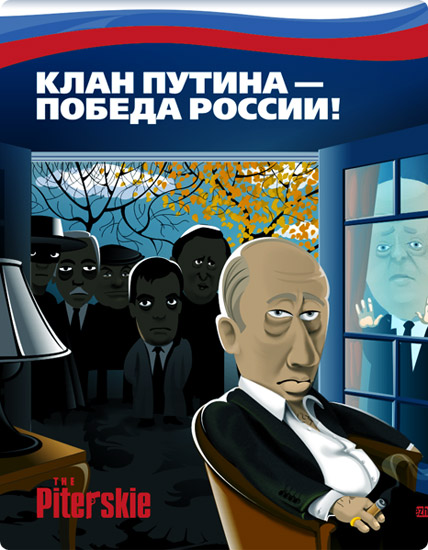
    And someone has already posted a distorted version of the Time cover (no doubt to make the Time editors look like even bigger meanies for making VVP look so bad), as well as a link to an earlier cartoon referring to "Putin's Clan" as opposed to "Putin's Plan" and using Sopranos-type imagery.

    RIA Novosti created a special "collage" rather than use Time's actual cover image.